
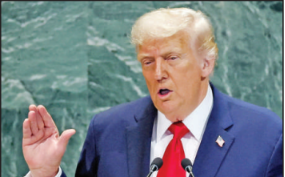
U.S. President Donald Trump. (File photo)
A war stopping is better than a war continuing. The reopening of the Strait matters to millions of ordinary people around the world who never asked for any of this.
After months of fighting, thousands of deaths, a strangled global economy and a Middle East that looks considerably more dangerous than it did before, the United States last week signed a one and a half-page memorandum of understanding with Iran that returns things to roughly where they were on February 27th, the day before the bombs started falling. The Strait of Hormuz is reopening. Nuclear negotiations can resume. Ships can sail again. We’re back to where we started. President Donald Trump has presided over many controversial decisions, but this one deserves a category of its own. The Iran war wasn’t just costly; wars are often costly, and sometimes the costs are worth bearing. This one was costly and unnecessary, built on a strategic miscalculation so fundamental that it’s worth stating clearly, because the United States is going to be living with the consequences for years.
Here’s what American and Israeli planners believed in February. Iran’s regime was brittle and that a short, sharp military campaign would not only shatter it, the Iranian people, long suffering under a repressive theocracy, would seize the moment to overthrow their rulers. Netanyahu said he had waited his entire political life for this opportunity. Trump made video addresses predicting the fall of the regime in Tehran. What they got instead was the opposite of everything they predicted.
On February 28th, Israel killed Supreme Leader Ayatollah Ali Khamenei and his closest advisers in a series of devastating surprise strikes. Almost simultaneously, an American airstrike hit a school in the southern Iranian city of Minab, where more than 150 people were killed, at least 120 of them schoolchildren, mostly girls under the age of twelve. Whatever moral authority the United States might have claimed as a liberating force evaporated in that moment, and in the moments that followed. What’s more, Iran did not collapse. The regime replaced its leadership with startling speed. Khamenei’s son, Mojtaba, was elevated to Supreme Leader and a younger generation of Revolutionary Guards commanders stepped into the vacuum. If anything, these new leaders were more radical than the old guard, less cautious and more willing to take risks. They had just survived what Iran had always feared most, a full-scale regime-change attempt by America and Israel, and survival had given them something dangerous: confidence. They closed the Strait of Hormuz, struck Iran’s Arab neighbours and hit American bases across the region. They even attacked Israel. The inexperienced US Defence Secretary, former chat-show host Peter Hegseth, repeatedly claimed that American military power had crippled Iran’s armed forces. He was wrong each time he said it. The war that was supposed to last weeks dragged on, burning through hard-to-replace American weapons stockpiles and demonstrating in the most public way imaginable that there are real limits to what US military force can achieve.
The human costs deserve to be stated plainly, not buried in geopolitical abstraction. Thousands of people in the Middle East are dead. Homes and businesses are destroyed. The closure of the Strait of Hormuz, through which roughly twenty percent of the world’s oil and natural gas normally flows, has rippled outward in ways that will hurt people far from any battlefield. Fertiliser production dependent on petrochemical shipments through the Strait has been disrupted and food security experts are warning that countries in sub-Saharan Africa face genuine hunger risks later this year. Wars have a way of sending their damage into places nobody planned for and onto people who had nothing to do with the original argument.
And for what?
That’s the question that keeps asserting itself. The memorandum of understanding that now exists is not a peace deal and is hated by Israel, which feels threatened by it. The MoU extends the ceasefire, reopens the Strait, lifts the naval blockade of Iranian ports, and deliberately defers the many genuinely hard questions, such as Iran’s nuclear programme, the scope of sanctions relief, and the long-term security architecture of the region. Those questions will go back to negotiators, who will sit across tables from each other and try to work things out. Which is, of course, exactly what Iranian and American negotiators were doing in Geneva on February 27th, the day Netanyahu persuaded Trump to bomb Iran. Multiple sources confirm that those talks were substantive, that Iranian diplomats believed they were in a serious process and had put real concessions on the table. The war didn’t just fail to improve on that situation. It destroyed it, killed thousands of people, destabilised the global economy, and then arrived back at the same destination anyway.
The damage to America’s strategic position extends well beyond Iran. The Gulf monarchies, Saudi Arabia, the UAE, and others, have built their entire identity around being stable, reliable American partners in a volatile region. That identity depends on the United States being a predictable, competent guarantor of regional security. What they witnessed instead was an impulsive war, launched by an impulsive US president while negotiations were ongoing, that failed to achieve its stated objectives and dragged the region into chaos. Privately, Gulf officials are already talking about diversifying their allegiances, about finding ways to coexist with Iran rather than relying on Washington to contain it. These are relationships that took decades to build. Repairing them will take years.
Then there’s China, which has been watching all of this with quiet attention. Every burned weapons stockpile, every embarrassed ally, every demonstration of American limits, all register somewhere in Beijing’s strategic calculus. The United States remains the world’s pre-eminent military and economic power; that hasn’t changed. But the Iran war made it look like a superpower under an erratic and amateurish president struggling to translate that power into outcomes.
Israel finds itself in a particularly uncomfortable position, and there are indications that its government will try to sabotage any talks that might prevent it from eliminating Hezbollah in Lebanon. Benjamin Netanyahu was Donald Trump’s full partner in launching the war on Iran, but was excluded from the negotiations that ended it. Netanyahu, who declared on February 28th that he had waited his entire political life for the chance to destroy the Islamic Republic, now faces a general election before October while political opponents accuse him of having endangered Israeli security. His defence minister insists that Israeli occupation of land in Lebanon, Syria, and Gaza will continue “indefinitely,” even though the MoU states that there will be “an immediate and permanent termination of military operations on all fronts, including in Lebanon”. Other hardliners in Netanyahu’s cabinet, such as minister of national security, Itamar Ben-Gvir, and finance minister, Bezalei Smotrich, are still calling for the annexation of southern Lebanon. On Friday, Ben-Gvir shockingly posted “For every tear of an Israeli mother, a thousand Lebanese mothers must weep. All of Lebanon must burn”. The relationship between Washington and Jerusalem, always complicated, has grown visibly strained in ways that neither side quite knows how to navigate. It was alleged that Trump called Netanyahu “f***ing crazy” during a tense, expletive-laden phone call last Monday, adding that Netanyahu would be in prison “if not for me”!
Meanwhile, the Iranian people to whom Trump on February 28th made stirring promises of freedom and a better future, are still governed by the same theocracy, harder now and more entrenched, emboldened by survival. In January, before the war, that regime killed thousands of its own citizens for daring to protest in the streets. Nothing about that has changed. If anything, a regime that has just successfully resisted a regime-change attempt by the world’s most powerful military is going to feel considerably more secure in its brutality, not less. All thanks to Donald Trump.
There is, of course, relief in the ceasefire and MoU, genuine relief, and it would be churlish not to acknowledge it, following 13,000 American airstrikes on the country which killed almost 3,500 Iranians. A war stopping is better than a war continuing. The reopening of the Strait matters to millions of ordinary people around the world who never asked for any of this. The possibility of renewed nuclear negotiations is better than the alternative. But relief is a very small return on the investment that was made.
The Iran war will be studied for years in war colleges, in foreign policy seminars, in the memoirs of officials who will spend considerable energy explaining why they supported it or how they tried to stop it. The lesson it teaches is old, simple and apparently inexhaustible in its capacity to be forgotten: that military force deployed in the service of magical thinking by leaders such as Trump doesn’t produce victories. It produces ceasefire agreements that look remarkably like the diplomatic situation that Trump and Netanyahu blew up to start the war.
*John Dobson is a former British diplomat, who also worked in UK Prime Minister John Major’s office between 1995 and 1998. He is currently a visiting fellow at the University of Plymouth.

Leave a Reply