
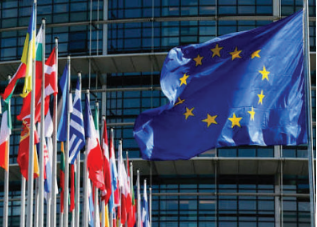
Europe’s moment of strategic autonomy and the possibility of a new renaissance
President Trump’s unilateral resignation from the role of the world’s policeman may ultimately arrive at precisely the moment Europe needs to rediscover its own strategic autonomy.
“We are in a new age of empires and this time we are the colonies,” said Italian opposition leader Carlo Calenda, commenting on the geopolitical times we live in. “There is great interest in the United States, China and Russia to see the European Union dismembered, as commercially each of the countries would be far easier prey,” he observed.
Speaking at the FII Priority Europe 2026 conference in Rome, Albanian Prime Minister Edi Rama offered a very different perspective. “I speak about Europe as a convinced European, because I consider the European Union the most beautiful, surprising, and courageous political creation of humanity,” he said. According to Rama, the European Union remains “the most extraordinary political project ever created” and still possesses enormous potential despite its problems of competitiveness, decision-making capacity and internal fragmentation.
These contrasting views capture the dilemma facing Europe today. While geopolitical observers increasingly describe the European Union as politically irrelevant and in irreversible decline, the world around it is undergoing a profound transformation. The demise of Pax Americana, accelerated by President Biden’s withdrawal from Afghanistan, appears to have gathered further momentum following the Trump administration’s aborted attempt at regime change in Iran. Paradoxically, this debate is taking place in Versailles, where the treaty that ended the First World War also helped set the countdown to the Second.
Whether the Islamabad Memorandum of Understanding between the United States and Iran ultimately holds or spirals into another chaotic conflict, one reality is becoming increasingly clear: American hegemony is fading, and the President of the United States has voluntarily stepped away from the role of leader of the free world. The democratic world is now officially orphaned, with large corporations and autocracies increasingly competing for influence, power and monopoly.
History offers a useful parallel. The Industrial Revolution accelerated Europe’s race to India after the fall of Constantinople to the Ottomans. The Ottomans did not make trade impossible, but they took control of the principal overland routes and eastern Mediterranean trade corridors linking Europe and India. Through taxation, duties and political control, trade became more expensive, more regulated and less profitable. European powers responded by seeking alternative routes and new opportunities.
The Industrial Revolution intensified the demand for raw materials. Europe developed extraordinary technological capabilities, but without access to resources there could be no sustained growth. Today, the world stands at a similar turning point.
We are entering the mature phase of the information revolution, with artificial intelligence poised to fundamentally change how humanity works, governs and interacts. At the same time, it may deliver the final blow to the fossil-fuel era that underpinned industrial civilization for more than two centuries.
Geopolitically, we are witnessing a return to a world in which global corporations often possess greater information, influence and technological capabilities than many governments. A new scramble is underway, this time for critical minerals, advanced semiconductors, energy security and data infrastructure. What raw cotton and iron ore were to the Industrial Revolution, silicon, lithium, rare earths and fibre optics are to the intelligence revolution.
Yet unlike previous eras, the decisive resource may not be minerals alone. The artificial intelligence age will be heavily dependent on human capital.
This presents a challenge for Europe. Europe is growing old. Its median age is approximately 44 years, compared to 28.8 in India and around 41 in China. The European Union faces a long list of structural problems. As Rama observed, “Europe’s main problem is its lack of political capacity to define a common vision, make shared decisions, and implement them quickly.”
The continent has also struggled to convert scientific excellence into technological leadership. The European Union has produced roughly 400 unicorn companies, compared to more than 1,100 in the United States. The Russia-Ukraine war has brought conflict back to the European continent and forced difficult strategic decisions. It has also exposed Europe’s complexities: immigration pressures, disagreements over economic models, fragmented foreign policy approaches, separate defence strategies and competing national priorities.
As Pierroberto Folgiero, CEO of Fincantieri, Europe’s largest shipbuilder, observed at the conference: “We build a German frigate, a French frigate, an Italian frigate when the seas and waves are exactly the same.” to underline the fragmentation in Europe’s defence strategy. The remark captured Europe’s enduring dilemma.
The continent suffers from an adolescent identity crisis. Yet the scale, ambition and beauty of the political project that emerged from the ruins of two world wars cannot be diminished by the challenges involved in its execution.
The European Union was built on a simple but revolutionary premise: that European nations would never again fight a war capable of killing millions of their own citizens. By that standard alone, it remains one of the most successful political experiments in human history.
Ironically, the same technological forces that once drove European powers to seek colonies may now force Europe into another renaissance. If artificial intelligence eliminates large numbers of jobs and transforms labour markets, Europe’s demographic decline may appear less catastrophic than it does today. Labour shortages and ageing populations will remain challenges, but the equation itself may change as AI itself revolutionizes workflows and makes service roles redundant.
None of this removes the need for reform. Europe must find solutions to unplanned and often illegal immigration. It must secure its borders, develop a coherent economic strategy, ensure access to affordable and sustainable energy, and learn to speak with a more unified voice. The challenge is to find a common political language in its member states, reduce bureaucratic inertia and pivot more quickly when circumstances demand it. These are just a few of its structural problems.
Yet unlike many regions of the world, Europe does not need to build entirely new institutions. The hard work has largely been done. The systems are already in place. The continent and its leaders possess the wherewithal to stand up to autocracies, negotiate with whimsical billionaires if they can come to an agreement on strategy and find direction.
President Trump’s unilateral resignation from the role of the world’s policeman may ultimately arrive at precisely the moment Europe needs to rediscover its own strategic autonomy. In the year marking the 250th anniversary of American independence, the fulcrum of global power may gradually be shifting back toward the old continent, where experience, infrastructure and technological capacity meet ancient culture, history and, above all, the value of freedom and liberty.
Europe has paid the price of war. It understands its consequences better than most. That may prove to be its greatest strategic advantage in an era increasingly defined by uncertainty.
*Vas Shenoy is an Italian entrepreneur of Indian origin and the founder of the Indo-Mediterranean Initiative (cnky.in). He is the Chief Representative for Italy of the Indian Chamber of Commerce.

Leave a Reply