
Act I
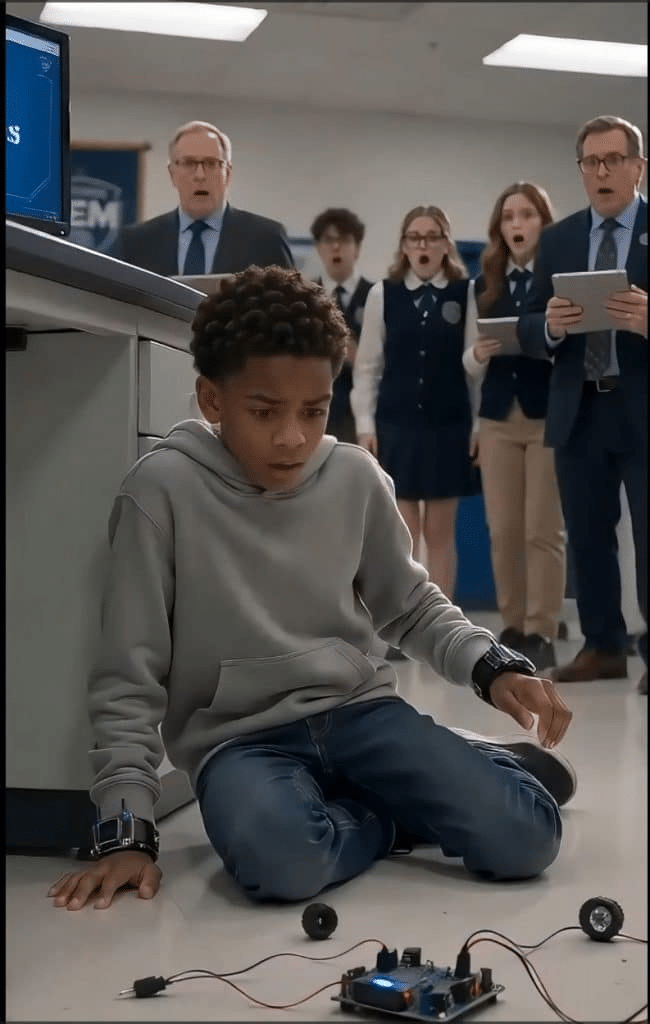
The slap cracked across the robotics lab, and tiny wheels scattered across the polished floor.
For one stunned second, every monitor kept glowing as if nothing had happened.
Then the room went silent.
Malik Edison fell beside the competition table, one knee hitting the floor as wires, screws, and a small control board spilled around him. His gray hoodie bunched at his shoulder. A small mark of blood appeared near his lip. The tool wristband on his arm flashed with tiny screwdrivers, the kind he had bought secondhand and cleaned until the metal shone.
At his feet, the robot lay half-open.
Not broken.
Not yet.
Its wheels trembled from the impact, one wire loosened near the sensor housing.
Around him, the private robotics school froze.
Glass walls reflected uniformed students. Workbenches held small competition robots with polished frames and sponsor stickers. STEM banners hung from the ceiling. Wealthy parents stood near the judges’ table with tablets, designer handbags, and the satisfied expressions of people who believed intelligence became more official when it came with tuition.
Standing over Malik was Preston Vale.
Navy blazer. Tech-company badge. Expensive smartwatch. A tense, controlling face sharpened by the kind of fear parents call ambition when they aim it at their children.
He had seen Malik touch the robot.
That was all it took.
Preston leaned down, lips curled.
“Robots are for gifted children,” he said, loud enough for every student to hear, “not street trash playing with wires he doesn’t understand.”
The insult made the children go still in a way adults should have feared.
Malik did not answer.
He looked at the scattered control board first.
Then at the robot.
Then at Preston.
His eyes were wet, but not weak.
Focused.
Coldly bright.
A judge shifted in place.
A teacher took half a step forward.
Then stopped.
That pause was what Malik would remember.
Not the slap.
Not the sting at his mouth.
The pause.
A room full of adults had watched a grown man strike a thirteen-year-old boy, and for one terrible second, everyone waited to learn whether the boy was valuable enough to protect.
Then the glass lab door opened hard.
Principal Margaret Hale rushed in wearing a dark blue blazer, STEM school pin, and glasses that had slipped low on her nose. Two judges followed behind her, their tablets clutched like evidence.
Her face changed the moment she saw Malik on the floor.
Alarm.
Then shame.
Then protection.
She moved between him and Preston.
“Young Mr. Edison,” she said, voice formal and trembling with force, “your invention just won the national grant.”
The lab gasped.
A monitor behind the judges flashed.
Edison Robotics Grant
National Youth Engineering Award
Preston stared at the screen.
His mouth barely moved.
“Edison?”
Malik slowly picked up the tiny control board from the floor.
The boy Preston had called street trash was the inventor everyone in that lab had come to celebrate.
Act II
Malik Edison did not build robots because robots were expensive.
He built them because broken things told the truth.
His first robot was made from a toothbrush motor, bottle caps, an old TV remote, and wires stripped from a lamp his mother had been about to throw away. It moved three inches across the kitchen table, spun in a circle, and fell off the edge into a cereal bowl.
Malik was seven.
He laughed so hard his mother came running from the laundry room, terrified something had exploded.
When she saw the little machine twitching in the bowl, she covered her mouth.
“Baby,” she said, “what is that?”
Malik looked proud enough to light the apartment.
“A rover.”
They lived in a neighborhood where people fixed before they replaced. Fans, phones, bikes, microwaves, toys with missing wheels, radios that only worked when angled toward the window. Malik learned early that broken did not mean useless. It meant unfinished.
His mother, Tasha Edison, worked nights as a hospital transport coordinator and days whenever rent demanded it. She did not understand robotics, but she understood her son’s face when he talked about sensors, motors, and code.
So she kept a plastic bin under the sink for parts.
Old chargers.
Remote controls.
Dead laptops from neighbors.
Screws in medicine bottles.
A cracked tablet someone from the hospital gave her because the screen was too damaged to repair.
Malik used everything.
By ten, he was fixing classmates’ science fair projects.
By eleven, he was watching university lectures on a phone with one speaker blown out.
By twelve, he had built a small robot that could navigate around furniture using scavenged ultrasonic sensors and a processor board donated by a retired engineer from the community center.
The community center was where he met Mrs. Alvarez.
She had taught physics for thirty years before retiring, and she had no patience for children pretending not to be brilliant because adults were uncomfortable around hunger.
She looked at Malik’s robot, watched it avoid a chair leg, and said, “You need a lab.”
Malik shrugged.
“I have a kitchen.”
“No,” she said. “You have a mind. The kitchen is just where they’ve been making you store it.”
She helped him apply for a regional youth engineering showcase. He won. Then a state challenge. He placed first. Then a national grant competition for student inventions with real-world applications.
Malik submitted his project under the title Rescue Rover: Low-Cost Navigation for Collapsed Structures.
The robot was small, ugly, and brilliant.
It could enter tight spaces after earthquakes, fires, or building collapses. It used cheap modular parts, simple mapping logic, heat sensors, and audio detection to locate trapped people where larger machines could not go. Malik designed it after a fire in his apartment building left firefighters searching smoke-filled rooms with limited visibility.
He did not call it innovation.
He called it remembering.
The national judges noticed.
So did Helix Preparatory Robotics Academy, the private school hosting that year’s final demonstration.
Helix invited Malik to present his prototype in their glass-walled competition lab.
The school called it outreach.
The parents called it publicity.
Malik called it a chance to use tools that were not borrowed, broken, or balanced on a kitchen chair.
He arrived in a gray hoodie, jeans, and sneakers with one sole starting to peel.
His tool wristband was secondhand.
His robot had no sponsor decals.
And to people like Preston Vale, that made him look like someone who had wandered into the wrong future.
Act III
Preston Vale had spent twelve years trying to manufacture genius in his son.
His son, Oliver, was not untalented.
That was part of the tragedy.
Oliver liked robotics when no one watched. He liked making small machines draw crooked circles. He liked programming lights to blink in patterns. He liked the quiet satisfaction of seeing a motor obey code.
But Preston did not want a boy who liked robotics.
He wanted a prodigy.
He bought Oliver private coaches, elite camps, imported kits, competition memberships, custom sensors, and a workstation that looked more professional than most startup labs. He had a spreadsheet tracking Oliver’s rankings, scholarships, and “innovation trajectory.”
Oliver was thirteen and already tired.
Helix Academy had become Preston’s stage.
He donated to the lab. He sponsored the competition banner. He wore his tech-company badge to school events even when no one asked, because he liked parents remembering that he belonged to the world of founders, investors, and people who said “scale” as if it were a moral virtue.
When he heard an outside student had been invited to the national grant demonstration, he was irritated.
When he learned the student had no private school affiliation, he became suspicious.
When he saw Malik Edison beside the competition table, adjusting a wire on the Rescue Rover with calm precision, Preston decided suspicion was certainty.
“Who is that kid touching the finalist bot?” he asked.
A teacher said, “That’s Malik Edison.”
Preston frowned.
“From which team?”
“He’s presenting individually.”
“Individually?” Preston repeated, as if the word itself were cheating.
Across the room, Oliver watched Malik work.
Not with jealousy.
With awe.
Malik’s robot was different from the others. It did not look sleek. It looked necessary. Every piece had a reason. Every wire was routed for repair, not display. The chassis had been modified by hand. The sensor array was ugly in the way homemade brilliance often is before funding makes it photogenic.
Oliver stepped closer.
“That’s cool,” he said softly.
Preston heard him.
Something tightened in his face.
He did not want his son admiring a boy in a hoodie with scuffed sneakers. Admiration was supposed to flow downward from expensive achievement, not upward toward someone who had built more with less.
Malik reached toward the robot’s wheel assembly.
Preston crossed the lab.
“Don’t touch that.”
Malik looked up.
“It’s mine.”
Preston laughed.
“Excuse me?”
“The rover. I built it.”
Preston looked at the scattered tools, the worn wristband, the hoodie, the absence of a school blazer.
“No, you didn’t.”
Malik’s face closed slightly.
“I did.”
Preston stepped closer.
“My son’s team has been preparing for this showcase for months. I’m not letting some outsider interfere with equipment he doesn’t understand.”
Malik’s fingers rested lightly on the robot.
“It’s my project.”
Preston heard confidence from the wrong child.
That was all his anger needed.
He slapped Malik across the face.
The robot parts scattered around his knees.
And every child in the lab learned what some adults truly meant when they said gifted.
Act IV
Principal Margaret Hale had built her reputation on opportunity.
At least, that was what she said in speeches.
She believed it too, most days. Helix Academy had scholarships, outreach programs, diversity brochures, and photos of smiling students holding robots under banners that promised the future belonged to everyone.
But institutions can lie softly.
Not always in mission statements.
Sometimes in pauses.
Margaret was in the judges’ conference room when she heard the slap. Then the gasp. Then the particular silence that follows an adult crossing a line everyone recognizes but nobody wants to name first.
She moved before thinking.
When she reached the lab and saw Malik on the floor, she felt the full weight of every compromise she had ever excused.
The parents who spoke over scholarship students.
The donors who called outreach children “guests” instead of competitors.
The staff who were told to smooth things over because funding was delicate.
The brilliant boy on the floor had not been failed by one man only.
He had been failed by the room that hesitated.
Margaret stepped in front of Preston.
“Mr. Vale, move away from him.”
Preston straightened.
“This child tampered with a competition robot.”
One of the national judges, Dr. Priya Sethi, lifted her tablet.
“No,” she said. “He was repairing his own prototype.”
Preston blinked.
The other judge turned the nearest monitor toward the room.
Edison Robotics Grant
Winner: Malik Edison
Project: Rescue Rover
The students leaned in.
The parents whispered.
Oliver stared at his father as if seeing him through new glass.
Margaret crouched beside Malik, careful to keep her voice steady.
“Young Mr. Edison, your invention just won the national grant.”
Malik swallowed.
He did not smile.
His eyes moved from the screen to the scattered parts on the floor.
“Is the rover disqualified?” he asked.
That question broke something in the adults watching.
Not Am I safe?
Not Did he hurt me?
The first thing the boy asked was whether the work had survived the humiliation.
Dr. Sethi knelt and picked up a tiny wheel.
“No,” she said gently. “The rover is not disqualified.”
Malik nodded once.
Then he looked at Preston.
“You thought I was touching something that belonged to your son,” he said.
Preston’s jaw tightened.
“I made a mistake.”
Malik’s voice stayed calm.
“You hit me before you knew what belonged to me.”
The lab went silent again.
This time, the silence did not protect Preston.
It exposed him.
Margaret stood.
“Mr. Vale, you are removed from this event.”
Preston’s face flushed.
“My family funds this program.”
“Not anymore.”
The words left Margaret before she had time to fear them.
A murmur moved through the parents.
Preston took a step back.
“You cannot ban me from a school competition.”
“I can remove any adult who assaults a child.”
Oliver’s voice came from behind him.
“Dad, stop.”
Preston turned.
Oliver’s face was pale.
The boy’s hands were clenched around his own team badge.
“You slapped him,” Oliver said.
Preston opened his mouth.
But there was no version of ambition that could make that sentence sound like love.
Act V
The video spread before the judges finished repairing the demonstration table.
Fifteen seconds.
The slap.
The robot wheels and wires scattering around Malik’s knees.
Robots are for gifted children, not street trash playing with wires he doesn’t understand.
Then Principal Hale rushing through the glass lab door.
Young Mr. Edison, your invention just won the national grant.
Then Preston Vale’s broken whisper.
Edison?
People loved the reversal.
They loved the panic in Preston’s face. They loved the glowing grant screen. They loved discovering that the boy in the hoodie was not an outsider touching elite equipment, but the inventor whose project had just beaten every polished machine in the room.
Malik did not love the lesson people repeated.
Be careful who you disrespect. They might be a genius.
That was not a lesson.
That was another test children should not have to pass.
His mother hated it even more.
When Tasha Edison arrived at the school and saw the mark near her son’s lip, the room learned what real restraint looked like. She did not scream. She did not perform grief for cameras. She went to Malik first, touched his cheek gently, and asked, “Do you want to leave?”
Malik looked toward the robot.
“No,” he said. “I want to run the demo.”
Tasha closed her eyes for one second.
Then nodded.
“Then run it.”
The judges gave him time to reassemble the rover. No adult was allowed to touch it unless Malik asked. That became important. He did not want pity repairs. He wanted his machine working because he understood it.
His hands moved fast.
Tiny screwdriver.
Wire.
Wheel.
Control board.
Sensor housing.
Oliver approached slowly, holding a replacement connector from his own kit.
“I have one that fits,” he said.
Malik looked at him.
For a moment, the whole lab held its breath.
Then Malik took it.
“Thanks.”
Oliver nodded, eyes wet.
“My dad was wrong.”
Malik returned to the wiring.
“Yeah.”
It was not forgiveness.
It was accuracy.
Sometimes that is all a child can offer without being asked to heal too quickly.
When the Rescue Rover finally powered on, the lab lights dimmed for the demonstration. A simulated collapse maze had been built at the far end of the room with foam blocks, smoke-safe fog, heat markers, and hidden audio beacons.
The polished team robots looked beautiful under the monitors.
Malik’s looked like it had survived a fight before the test even began.
Then it moved.
Small wheels turning.
Sensors blinking.
A soft mechanical hum filling the lab.
It entered the maze, paused at the first obstacle, mapped the opening, adjusted, and crawled under a narrow gap none of the larger robots had been able to pass. The monitor showed its live scan: heat signature detected, audio marker confirmed, route plotted.
The judges leaned forward.
The students forgot to look cool.
Oliver whispered, “Whoa.”
Malik stood still, tool wristband against his sleeve, eyes locked on the screen.
The rover found all three hidden targets in under four minutes.
The lab erupted.
Not polite applause.
Not donor applause.
Real applause.
The kind children make when they have witnessed something impossible become obvious.
Principal Hale stepped to the front of the room afterward.
She did not hold a prepared speech.
Good.
Prepared speeches had failed enough already.
“What happened here today,” she said, “was not only an assault by one parent. It was a failure of a culture that allowed a child to be judged by appearance before achievement, and by achievement before humanity.”
The parents shifted.
Some looked ashamed.
Some looked defensive.
A few looked angry that shame had entered a room they had paid to make comfortable.
Margaret continued.
“Helix Academy will not accept funding from families who believe donations purchase permission to demean children.”
That sentence cost the school money before the day ended.
Preston Vale withdrew his sponsorship through attorneys. His company released a statement about “an emotional misunderstanding during a competitive educational event.” The clip made that language collapse under its own cowardice.
The national grant board issued its own statement.
Malik Edison’s work was selected for its originality, social impact, and engineering excellence. No student’s dignity is conditional on institutional affiliation.
That line traveled.
So did Malik’s robot.
The grant funded a real lab for him and his community center. Not a symbolic corner with donated posters. A working space. Tools. Printers. parts. mentors. Safety equipment. After-school hours. Weekend build sessions.
Mrs. Alvarez cried when the first shipment arrived.
Then immediately yelled at the delivery crew for blocking the emergency exit.
Malik smiled for the first time in days.
The Rescue Rover project grew beyond the competition. Fire departments tested prototypes. University engineers volunteered. A disaster-response nonprofit asked to partner. Malik was still thirteen, so Tasha insisted every meeting happen after homework and before dinner unless there was pizza.
He remained a child.
That mattered.
The world kept trying to turn him into a symbol.
Prodigy.
Genius.
Future billionaire.
Young Edison.
Malik disliked most of it.
He liked building.
He liked solving problems.
He liked when younger kids at the community center stopped asking whether they were allowed to use the tools and started asking what they could make.
One girl built a robotic arm from cardboard and servo motors. A boy designed a trash-sorting rover that mostly chased feet. Oliver came once, standing awkwardly in the doorway with a backpack full of parts and no father beside him.
Malik saw him and said, “Bench three is open.”
Oliver looked relieved enough to cry.
They did not become best friends instantly.
Life is not a clean circuit.
But they worked.
That was a beginning.
Preston Vale lost more than access to Helix. His company board placed him on leave after employees began sharing stories of his temper. Former interns wrote about being mocked in meetings. Junior engineers described ideas dismissed until repeated by wealthier men. The robotics lab incident became a lens, and through it people saw a pattern.
Preston tried to apologize publicly.
Malik did not attend.
Tasha read the statement and said, “He apologized to his reputation.”
Malik kept soldering.
Years passed.
The Edison Robotics Grant became an annual program for student inventors without access to expensive labs. Malik insisted the application not require professional video, polished prototypes, or school sponsorship. Applicants could submit sketches, phone recordings, broken models, written explanations, or community recommendations.
“Some ideas are still wearing hoodies,” he said during the first award ceremony.
Everyone laughed.
Then wrote it down.
At nineteen, Malik stood in a university robotics lab much larger than the room where he had been slapped. His Rescue Rover design had evolved into a modular search-and-rescue platform used in training exercises across several states. It was still affordable. Still repairable. Still built around the principle that technology should reach people before headlines did.
He returned to Helix Academy only once.
Principal Hale invited him to speak at the dedication of the new open-access engineering wing, funded partly by donors who had joined after the scandal and partly by money the school redirected from prestige programs that looked better in brochures than in children’s lives.
Malik almost said no.
Then Mrs. Alvarez told him, “Don’t let the worst room keep the last word.”
So he went.
The glass walls were the same.
The monitors were newer.
The STEM banners had changed.
On one wall, a framed photograph showed the first Rescue Rover prototype with scratched wheels and exposed wiring. Beneath it was a small plaque.
Built before permission arrived.
Malik stood before students, parents, judges, and teachers. Some of them remembered the video. Most pretended not to.
He did not mention Preston by name.
He did not need to.
“I used to think robots were about control,” he said. “You write code, and the machine obeys. You build the frame, and the parts follow.”
The room listened.
“But the best robots I’ve worked on don’t exist to control the world. They exist to enter places people are afraid to go, find what others missed, and bring back proof that someone is still there.”
His mother sat in the front row.
Mrs. Alvarez dabbed her eyes and denied it.
Malik looked toward the younger students.
“Engineering is not for gifted children.”
The room tightened, recognizing the echo.
“It is for stubborn children. Curious children. Angry children. Quiet children. Children who take broken things apart because they believe the inside might explain the outside.”
He paused.
“And no adult gets to decide your mind is poor because your tools are.”
That became the line people remembered.
Still, people continued telling the old story.
They told it as karma.
A rich robotics parent slaps a poor boy and discovers he is Young Mr. Edison, winner of the national grant.
They loved the twist.
The gasp.
The scattered robot parts.
The father’s face when the boy on the floor became the smartest person in the room.
But Malik never told it that way.
Because the truth was not that Preston slapped the wrong child.
The truth was that he believed there was a right one.
He believed robots were for gifted children.
Malik knew better.
Robots were for questions.
For kitchen tables covered in parts.
For mothers saving broken chargers in plastic bins.
For community centers with flickering lights.
For teachers who see a mind before the world sees a résumé.
For children whose first lab is the floor.
For wires no one understands yet.
For machines built not to impress judges, but to crawl through darkness and find someone breathing.
When the tiny wheels and wires scattered around Malik Edison’s knees, the lab did not discover that he belonged because his invention had won.
It discovered how quickly adults can mistake access for ability.
And from that day forward, every student who entered the Edison Robotics Lab learned the rule written above the workbenches.
Build first.
Let the world catch up.
