
It was the most innocent, cheerful-looking sticker, yet it held a pain so profound it threatened to shatter everything in its path. When a well-meaning mother turned to Millie Smith and whispered those three simple, devastating words—”You’re so lucky”—she had no idea she was speaking to a mother whose world had just collapsed. Millie stood there, frozen, her heart splintering into a thousand pieces as she clutched the secret of her missing child. She realized right then that she had to change everything, or other grieving parents would continue to endure this unimaginable, avoidable torture in silence.
In November 2015, Millie Smith and her partner, Lewis Cann, were overjoyed to welcome their first child. When they learned they were expecting again, and specifically carrying twins, the happiness was immeasurable. Yet, deep down, Millie possessed an intuitive, unshakable gut feeling that she was carrying more than just one baby. Her family history was filled with twins, but this felt different.
The turning point came during a routine scan. Excitement filled the room until the atmosphere shifted instantly. The sonographer, usually chatty and reassuring, suddenly went completely silent. Both Millie and Lewis knew, with the terrifying clarity only parents can possess, that something was profoundly wrong. Their fears were confirmed when doctors delivered the devastating diagnosis: one of the babies was suffering from anencephaly.
According to the CDC, anencephaly is a severe birth defect where a baby is born without parts of the brain and skull. The prognosis was as bleak as it was heartbreaking; the condition is fatal, and the doctors were forced to explain that almost all infants born with this diagnosis pass away shortly after birth.
Despite the catastrophic news, Millie and Lewis chose to continue the high-risk pregnancy. They were determined to cherish every heartbeat, every moment, and every ounce of life they could offer their daughters. They named them Callie and Skye. The name “Skye” was chosen with intentional, poetic care, symbolizing a place they could always look toward to remember their baby, a place where she would always remain close to them even after she was gone.
On April 30, at just 30 weeks into the pregnancy, Millie went into labor, requiring an emergency C-section. The hospital staff, prepared for the tragedy, provided them with a bereavement midwife and access to a “Daisy Room.” This sanctuary allowed the couple to be with their infant in a private, supportive space both before and after she passed.
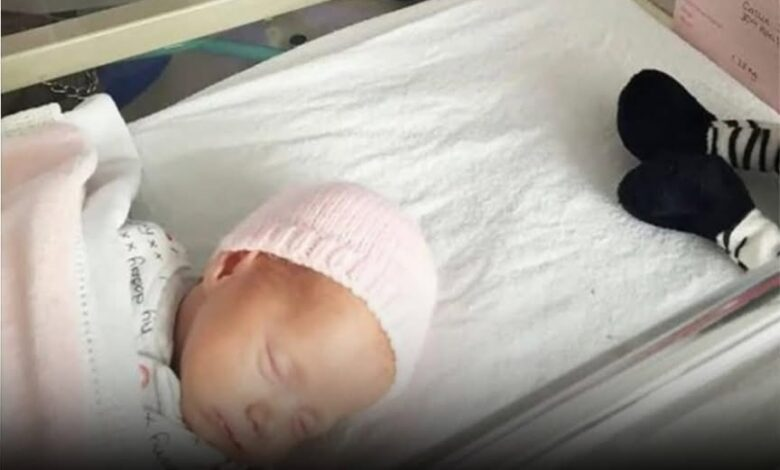
Against all expectations, both girls cried upon birth. It was a miraculous moment, as the parents had been warned that Skye would likely be unable to move or make a sound. For three precious, agonizing hours, Millie and Lewis held Skye. They cuddled her as she fought to spend time with them, and they held her as she finally slipped away. It was, in Millie’s words, the worst moment of their entire lives, a depth of heartbreak previously unimaginable. Yet, amidst that immense sorrow, there was a profound sense of pride that Skye had fought so hard to be with them.
Callie, meanwhile, was placed in the Neonatal Intensive Care Unit (NICU) to recover from her premature birth. The NICU is a space defined by high-intensity emotions—a place where parents are on edge, waiting for news, and trying to navigate the complexities of caring for fragile infants. In this environment, people are often looking for connection, and conversations between parents are common.
While most of the nursing staff were aware of the tragic loss of Skye, the reality of the situation began to fade from the communal memory of the ward. After about four weeks, new parents in the unit began to treat Millie as the mother of a single baby, completely unaware of the sister who had been lost. It was during this time that a frazzled, exhausted mother of healthy twins turned to Millie and innocently remarked that she was “so lucky” not to have to deal with the demands of two infants.
That comment was not malicious; it was a desperate, tired observation from a mother overwhelmed by her own reality. She had no way of knowing that she was speaking to a woman who had, until very recently, been carrying two. But to Millie, those words were like a physical blow. She felt the sudden, crushing weight of her grief resurface with unbearable intensity. She didn’t have the heart to explain, yet the pain was too much to bear; she fled the room in tears, leaving the other mother confused and entirely unaware of the trauma her words had inflicted.
In that moment of absolute devastation, clarity emerged from the chaos. Millie knew she could not change what happened to her family but she knew she could spare others from this agonizing, inadvertent cruelty. She realized that a simple, visual signal was needed to communicate the situation to staff and visitors without forcing bereaved parents to recount their trauma every time they walked into the room.
She designed a poster and a system using a purple butterfly. The purple butterfly would be placed on the incubator of a baby who was the survivor of a multiple-birth loss. The butterfly was chosen to symbolize the babies who had “flown away,” while the color purple was selected for its neutrality, suitable for both boys and girls.
Millie’s initiative, now known as the Skye High Foundation, has transcended borders, expanding to hospital in many different nations. It has become a vital, compassionate tool that protects the emotional well-being of families in the most vulnerable stages of their lives. Callie, now seven years old, is a joyful, vibrant child, and her sister’s legacy lives on in every butterfly sticker that guards a family’s grief. Through these simple symbols, Millie Smith has ensured that while Skye’s time on earth was short, her impact is enduring, turning a moment of profound darkness into a beacon of awareness and comfort for parents everywhere.
