
Act I
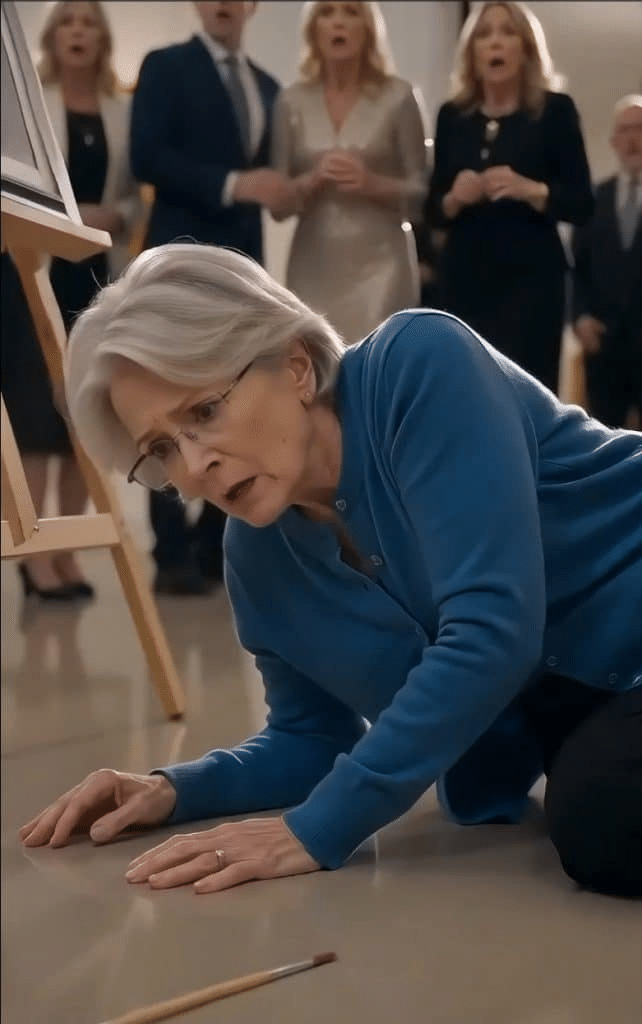
The slap cracked through the gallery, and the paintbrush rolled across the polished concrete floor.
For one breath, even the judges stopped writing.
Professor Eleanor Langley stumbled backward into an easel stand, her blue cardigan catching on the wooden frame before she dropped to one knee. A small mark of blood appeared near her lip. Her thin glasses slid down her nose, and one paint-stained finger pressed against the floor to steady herself.
The brush kept rolling.
It crossed beneath a student painting of a girl standing alone in a blue kitchen and stopped near the toe of a polished designer heel.
The gallery went silent.
White walls held rows of final student exhibits. Gold-framed faculty portraits watched from above like old witnesses too proud to interfere. Wealthy parents in tailored dresses and sharp suits stood in clusters, champagne untouched in their hands. Judges held tablets against their chests, stunned into stillness.
Standing over Langley was Victoria Ellison.
Sleek brunette hair. Ivory blazer. Gold earrings. An impatient sneer polished by years of charity lunches, private school auctions, and rooms where money had always spoken before talent.
She pointed toward the fallen brush.
“You hang children’s paintings and sweep the floors,” Victoria said, her voice sharp enough to cut the air. “Don’t act like low-class trash can understand art.”
A few students flinched.
No one moved.
That was what Langley noticed.
Not the sting on her cheek.
Not the blood at her lip.
The silence.
A gallery full of adults had just watched a woman be struck in front of children, and everyone waited to learn whether she was important enough to defend.
Langley slowly lifted her eyes.
They were gray, intelligent, and suddenly very far away.
Victoria mistook that distance for weakness.
“What?” she snapped. “Are you going to report me to maintenance?”
Then footsteps stopped at the gallery entrance.
The Academy Headmaster stood there with three board members behind him, his black suit immaculate, silver tie catching the white gallery light. His face went pale the moment he saw Langley on the floor.
Not confused.
Ashamed.
He walked toward her with careful urgency, as if the entire academy had shifted beneath his feet.
“Professor Langley,” he said, voice formal and loud enough for every parent, student, judge, and donor to hear, “the board is ready to unveil the wing named after you.”
The room gasped.
A staff member pulled a covered plaque into view near the far wall.
The cloth slipped.
Langley Fine Arts Wing.
Victoria’s lips parted.
Her face lost its color beneath the perfect makeup.
“Langley?”
Professor Eleanor Langley rose slowly, picked up the fallen paintbrush, and looked at Victoria with the distant calm of someone who had just watched ignorance reveal itself in public.
The woman Victoria had called low-class trash was the most respected artist the academy had ever produced.
Act II
Eleanor Langley had been painting before she knew galleries existed.
Her first studio was a basement laundry room in Cleveland, between a rusted water heater and a folding table that belonged to no one because every tenant used it. Her mother worked double shifts at a pharmacy. Her father had left behind three coats, a box of unpaid bills, and a set of cheap oil paints he had once bought during a week when he believed he might become a different man.
Eleanor found the paints at nine.
The tubes were stiff.
The colors had separated.
She used them anyway.
She painted on cardboard first. Then grocery bags. Then the backs of church flyers. She learned that blue could be sadness or morning, depending on how much gray she mixed into it. She learned that faces were hardest around the mouth, because people lied there before they lied with words.
No one in her building talked about art as a career.
Art was something printed on calendars or hung in doctors’ offices. It was not something a girl with paint under her nails could claim.
But Eleanor kept painting.
At thirteen, she drew every woman in the building from memory.
Mrs. Alvarez carrying laundry with one hip against the basket. Mrs. Chen counting coins beside the vending machine. Her mother asleep at the kitchen table with one shoe still on. The women looked exhausted, irritated, beautiful, and unposed.
A local teacher saw the drawings and entered one into a student exhibition without asking.
Eleanor won.
She hated the attention.
Then loved the room.
Not the praise. Not the ribbon.
The room itself.
White walls. Quiet footsteps. People slowing down to look at something made by her hand.
For the first time, Eleanor understood that looking could be a form of respect.
Years later, she won scholarships, worked through art school, and became known for portraits of overlooked labor: janitors, cleaners, nurses, cooks, immigrant shopkeepers, women waiting at bus stops, old men repairing shoes, children watching adults pretend not to be tired.
Critics called her work unsentimental.
Collectors called it severe.
Students called it honest.
Eventually, private academies began inviting her to lecture. Museums asked for retrospectives. Wealthy collectors who had once walked past the kind of people she painted now paid millions to hang their faces in climate-controlled rooms.
Eleanor found that darkly funny.
She accepted some honors and rejected others. She taught because teaching still felt dangerous in the right way. A student could enter a room believing talent was permission and leave understanding it was responsibility.
The Langley Fine Arts Wing was supposed to be her final public gift to the academy.
She donated the money anonymously at first.
Then the board insisted her name belong on the building.
She agreed only after demanding one condition.
The wing would include a scholarship studio open to students who could not afford private art tutors, portfolio consultants, or summer programs in Italy.
“Art has enough locked doors,” she told the board. “Do not put my name on another one.”
On unveiling day, she arrived early in a blue cardigan and black trousers.
No silk scarf.
No entourage.
No speech folder.
A little paint on one finger from a student canvas she had helped steady in the hallway.
A parent saw her adjusting a painting near the final exhibits and decided she was staff.
That parent was Victoria Ellison.
Act III
Victoria Ellison loved art the way some people love mirrors.
She loved the status of it.
The lighting.
The openings.
The language that made her feel intelligent when she repeated it correctly.
She served on museum benefit committees, bought abstract pieces after asking which ones were “important,” and spoke often about cultivating her daughter’s creative voice, though what she really wanted was a portfolio strong enough to place Isabelle Ellison in the academy’s most elite track.
Isabelle had talent.
A nervous, delicate talent that showed up in small pencil studies when no one hovered.
She drew hands beautifully.
She could capture tension in knuckles, fingers, wrists, the way a person held a glass when pretending not to be angry. But Victoria wanted large work. Bold work. Impressive work. Work that said her daughter had been raised around taste.
So Isabelle’s final exhibit had become a family project disguised as a student achievement.
Private coach. Imported pigments. Weekend studio rentals. A consultant who specialized in “narrative cohesion for admissions portfolios.” Victoria approved color palettes, rejected sketches, and corrected the statement until it sounded like a board member pretending to be seventeen.
The judges had already walked past Isabelle’s display twice without stopping long enough.
Victoria noticed.
She noticed everything that threatened the story she had paid to construct.
Then she saw Eleanor Langley standing near Isabelle’s painting.
Langley was studying it quietly, one finger marked with blue paint. Not touching the canvas. Not damaging anything. Just looking.
Victoria crossed the gallery.
“Excuse me,” she said.
Langley turned.
“Yes?”
“Are you assigned to this section?”
Langley looked at her for a moment.
“In a sense.”
Victoria’s eyes narrowed.
“Then why are you interfering with my daughter’s work?”
“I’m looking at it.”
“Staff should not hover near judging areas.”
A student nearby glanced up.
Langley’s face remained calm.
“I’m not staff.”
Victoria smiled thinly.
That was worse than anger.
It meant she had found someone to perform against.
“Of course. An assistant, then.”
Langley said nothing.
Victoria stepped closer.
“My daughter’s piece is being reviewed by serious judges. We don’t need someone smearing paint around and confusing the presentation.”
Langley looked back at the painting.
It was technically clean. Too clean. Beautiful colors, expensive surface, elegant composition.
But there was no pulse in it.
“She has a good eye,” Langley said.
Victoria brightened despite herself.
“Obviously.”
“But someone has taught her to be afraid of choosing wrong.”
The brightness vanished.
“What did you say?”
Langley turned fully toward her.
“Your daughter draws as if someone corrects her before the line is finished.”
The nearby students went still.
Victoria heard truth as humiliation.
“You have no right to critique her.”
“I was asked to judge the senior exhibits.”
Victoria laughed.
A short, cruel sound.
“You?”
Langley’s expression did not change.
Victoria looked at the cardigan, the trousers, the paint on the finger, the absence of jewelry, the quiet face that did not perform wealth.
She decided the woman in front of her could be crushed safely.
“You people always confuse proximity with expertise,” Victoria said. “You hang work. You clean brushes. You stand near art long enough and start imagining you understand it.”
Langley’s eyes cooled.
“Careful.”
That single word embarrassed Victoria more than a shout would have.
She raised her hand.
The slap echoed through the gallery.
The easel shifted.
The paintbrush fell.
And the academy discovered what kind of parent had been hiding behind the language of excellence.
Act IV
Headmaster Charles Pembroke had spent forty years learning that prestige can make cowards of institutions.
He knew it because he had been one.
Not always.
But enough.
He had allowed donors to interrupt teachers. He had softened disciplinary letters because families threatened gifts. He had watched parents bully admissions officers and called it passion. He had let wealth stand too close to the students and pretend it was support.
Professor Langley had warned him once.
“Schools don’t lose their souls all at once,” she said. “They loan them out room by room.”
He had admired the sentence.
Then failed to live up to it.
When he entered the gallery and saw Langley on the floor, blood near her lip, paintbrush rolling across the concrete, his shame arrived before his anger.
She had donated the new wing.
She had designed the scholarship program.
She had agreed, reluctantly, to let the academy celebrate her that afternoon.
And now she was on the floor beneath the portraits of faculty members who would have recognized the old pattern instantly: art praised in public, artists humiliated in private, labor invisible until prestige needed a story.
Pembroke moved toward her.
“Professor Langley,” he said, “the board is ready to unveil the wing named after you.”
The room changed.
Not loudly.
Deeply.
The students understood first.
Then the judges.
Then the parents.
Victoria looked toward the plaque as the cloth came away.
Langley Fine Arts Wing.
Her jaw tightened.
“I didn’t know.”
Langley picked up her glasses and cleaned one lens with the edge of her cardigan.
“No,” she said. “You didn’t.”
The simplicity of it was brutal.
Victoria swallowed.
“I thought she was interfering with my daughter’s work.”
Langley put her glasses back on.
“I was.”
A few people inhaled.
Langley looked at Isabelle’s painting.
“Your daughter is talented. But you have put so much polish over her fear that almost nothing alive can breathe through it.”
Isabelle’s face flushed.
Victoria moved toward her daughter protectively, but Isabelle stepped back.
That tiny movement broke something in the room.
Langley saw it.
So did Pembroke.
Victoria’s voice sharpened again, desperate now.
“This is inappropriate. My family has supported this academy for years.”
Pembroke closed his eyes for one second.
Then opened them.
“Yes,” he said. “And perhaps we have let that support cost too much.”
Victoria stared at him.
“You cannot be serious.”
“I am.”
“I want this woman removed from judging.”
Langley’s mouth curved faintly.
Not a smile.
An autopsy.
“I built the rubric they are using.”
The judges looked down at their tablets.
Victoria’s face went pale.
Pembroke turned to the gallery staff.
“Mrs. Ellison is to leave the exhibition area.”
Her gold earrings trembled as she stiffened.
“My daughter’s future is on these walls.”
Langley’s voice cut in, quiet and exact.
“Then stop standing in front of it.”
Silence.
Isabelle looked at her painting.
Then at the small sketchbook tucked under the table beside her display, the one Victoria had told her not to show because unfinished work made artists look amateur.
Langley noticed.
“May I see that?”
Isabelle hesitated.
Victoria snapped, “No.”
Isabelle picked it up anyway.
The gallery held its breath as she handed it to Professor Langley.
Inside were hands.
Dozens of them.
Her mother’s hand gripping a phone.
A judge’s hand holding a stylus.
A janitor’s hand folded around a mop handle.
Her own hand half-erased, half-drawn, caught between reaching and hiding.
Langley turned the pages slowly.
Then looked at Isabelle.
“This is where you are.”
Isabelle began to cry.
Not loudly.
Not dramatically.
Like someone finally hearing a door unlock.
Victoria took one step toward her.
Security stepped between them.
And for the first time in the academy gallery, the mother who thought she owned her daughter’s future realized she had just become the obstacle everyone could see.
Act V
The video spread before the plaque ceremony began.
Fifteen seconds.
The slap.
The paintbrush rolling across the gallery floor.
You hang children’s paintings and sweep the floors. Don’t act like low-class trash can understand art.
Then Headmaster Pembroke entering with the board.
Professor Langley, the board is ready to unveil the wing named after you.
Then Victoria Ellison’s broken whisper.
Langley?
People loved the reversal.
They loved Victoria’s panic. They loved the plaque. They loved discovering that the woman in the blue cardigan was not an assistant, not maintenance, not some low-level gallery worker, but the renowned professor whose name was being placed on the academy’s newest wing.
Professor Langley did not love the lesson people repeated.
Be careful who you disrespect. They might be famous.
That was not art.
That was social caution wearing moral makeup.
She had spent her life painting people who were never revealed to be secretly powerful. Cleaners. cooks. drivers. mothers on buses. children waiting in fluorescent hallways. Men and women whose dignity did not depend on a plaque, a title, or a room full of wealthy people suddenly gasping at their importance.
The slap was wrong before anyone knew her name.
The insult was wrong before the wing came into view.
The silence was wrong because the students had watched adults calculate whether intervention was socially safe.
That was what Langley said at the unveiling.
She stood beneath the covered plaque with the small mark still visible near her lip. Her glasses sat slightly crooked. The paint had dried on her finger. The board offered to postpone the ceremony, and she refused.
Postponement would have been another form of polishing.
She wanted the room to remain uncomfortable.
“The danger in art education,” she began, “is that we teach young people to see beauty before we teach them to see power.”
No one moved.
“We tell them line, color, composition, value, gesture. We tell them to study light. But we do not always teach them to study the room. Who speaks freely? Who is interrupted? Who is mistaken for help? Who is praised for borrowing pain from lives they never had to live?”
The students listened in a way adults rarely do.
Completely.
Langley looked toward Isabelle, who stood near the side wall with her sketchbook clutched against her chest.
“An academy that teaches art but tolerates humiliation has confused taste with culture.”
Pembroke lowered his eyes.
Good.
Shame had work to do.
The next week, Victoria Ellison’s family withdrew their annual donation in outrage. Her attorney sent a letter accusing the academy of emotional harm, reputational damage, and discriminatory treatment against “legacy families.”
Langley read the phrase twice.
Then placed the letter under a jar of dirty brushes to keep the lid from rolling.
The academy board panicked.
Briefly.
Then something unexpected happened.
Former students began writing.
Some described parents rewriting their portfolios. Some described being told their work was too poor, too ethnic, too angry, too quiet, too ugly, too working-class, too personal, too strange. Others remembered teachers who protected them. Others remembered teachers who did not.
A janitor named Luis wrote one sentence that Langley later kept folded in her desk.
I cleaned studios for nine years, and only three students ever asked my name before painting me.
The Langley Fine Arts Wing opened differently than planned.
The donors still came.
The press still came.
The plaque still gleamed under careful lighting.
But the first exhibition was changed.
Instead of polished senior projects arranged to impress patrons, Langley curated the students’ unfinished work.
Sketches.
Studies.
Failures.
Crossed-out ideas.
Color tests.
Self-portraits abandoned halfway.
Hands, faces, kitchens, bedrooms, bus windows, hospital waiting rooms, cracked phone screens, shoes by doors, grandmothers asleep in chairs, fathers seen from behind.
The show was called Before Approval.
Some parents hated it.
The students loved it.
Isabelle Ellison’s hand studies hung near the center.
Not under her mother’s preferred title, Legacy in Motion.
Under Isabelle’s own title.
What I Was Afraid to Draw.
The piece made people stop walking.
Not because it was grand.
Because it was true.
Victoria did not attend.
Her daughter did.
With her father, who stood quietly in the back and did not speak over her once.
Professor Langley watched Isabelle guide a judge through the drawings, explaining how hands reveal control, fear, work, tenderness, ownership, refusal.
The judge asked whether she planned to continue the series.
Isabelle nodded.
“I think I just started.”
Langley looked away before anyone could accuse her of softness.
The academy changed slowly after that.
Not perfectly.
Institutions rarely repent in clean lines.
But the wing became what Langley had demanded it become: a place where students without private advantages could work without apology. Scholarships expanded. Portfolio reviews became anonymous for the first round. Parents were banned from speaking to judges during final exhibits. Faculty received authority to remove adults who harassed students, staff, or instructors.
Most importantly, staff names appeared on the gallery walls during every exhibition.
Not as decoration.
As record.
The person who installed the lighting. The gallery assistant who hung the canvases. The custodian who prepared the floors. The technician who repaired the projector. The models who sat for figure drawing classes. The community members whose faces became studies.
Art, Langley insisted, was never made alone.
Even solitude had infrastructure.
Years passed, and the clip of the slap continued to resurface.
People still framed it as karma.
Rich mother attacks secret professor.
Pretentious parent humiliates famous artist.
Woman slaps the wrong gallery assistant.
Langley corrected the story whenever she had the energy.
“She should not have slapped an assistant either,” she would say.
That became the line more people remembered.
It appeared in essays about arts education. On posters in studio classrooms. In a student mural near the service entrance, painted beside a portrait of hands holding a brush, a broom, a tablet, and a frame hook.
Langley disliked being quoted.
Then tolerated it.
Then quietly approved when a scholarship student told her, “It sounds like something a person should already know, but apparently they need help.”
Langley said, “Most education is repeating what should have been obvious.”
The student wrote that down too.
Victoria Ellison faded from the academy’s social life but did not disappear from Isabelle’s story. That would have been too easy. Mothers do not become harmless just because rooms finally see them.
Isabelle spent years learning to draw without hearing correction before the line began. Some days she succeeded. Some days she painted over everything. Some days she called Langley too late at night and asked whether fear could be a medium.
Langley answered, “Only if you stop letting it hold the brush.”
Isabelle eventually became an artist, though not the kind her mother had tried to manufacture. Her first solo show featured hands of women in waiting rooms, hands of workers, hands of daughters, hands reaching toward paintings they were told not to touch.
In the catalogue, she wrote:
My first real teacher was the woman my mother mistook for someone who did not matter.
Langley read that sentence once.
Then closed the catalogue and sat alone for a long time.
On her seventieth birthday, the academy held a private dinner in the wing named after her. She refused speeches from donors but allowed students to speak if they kept it under two minutes.
No one did.
A former scholarship student, now a muralist, said Langley had taught him that beauty without witness becomes decoration.
A sculptor said she had learned to stop sanding away anger.
A teacher said Langley had once looked at her worst painting and said, “At least this one is lying badly. Now we can begin.”
Everyone laughed.
Langley almost did.
Then Headmaster Pembroke, retired and older now, stood with a glass of water in his hand.
“I owe Professor Langley an apology,” he said.
The room quieted.
“Not for the day she was struck. I apologized for that already, and badly. I owe her an apology for every day before it when I allowed money to stand too close to judgment and called it partnership.”
Langley looked at him for a long moment.
Then nodded once.
It was not forgiveness wrapped in sentiment.
It was acknowledgment.
At her request, the dinner ended not with a toast, but with an open studio hour. Students, alumni, staff, and faculty moved into the workrooms. Some painted. Some drew. Some only watched.
Langley sat near a table and cleaned brushes.
A young student rushed over.
“Professor, you don’t have to do that.”
Langley looked up.
“Why not?”
The student froze, hearing the trap but not yet understanding it.
Langley held up the brush.
“The hand that cleans the brush is not beneath the hand that paints with it.”
The student nodded slowly.
Then sat beside her and helped.
People still told the story of Victoria Ellison slapping a woman near a student painting and discovering she was Professor Langley, the legendary artist with a wing named after her.
They loved the twist.
The gasp.
The plaque.
The wealthy mother’s face when the woman on the floor became the authority in the gallery.
But Langley never told it that way.
Because the truth was not that Victoria slapped the wrong woman.
The truth was that she believed there was a right one.
She believed art belonged to people who could buy proximity to it.
Langley knew better.
Art belonged to attention.
To basement laundry rooms.
To brushes cleaned after midnight.
To children drawing on cardboard because canvas cost too much.
To janitors whose names should be remembered.
To mothers asleep at kitchen tables.
To students brave enough to draw what their parents told them to hide.
To assistants who hang paintings straight.
To teachers who refuse to confuse polish with truth.
To every person who has ever stood before a blank surface and tried to make the invisible visible.
When the paintbrush rolled across the gallery floor, the academy did not discover that Professor Langley deserved respect because her name was on a plaque.
It discovered how quickly people deny intelligence to anyone they have mistaken for service.
And from that day forward, the Langley Fine Arts Wing taught the lesson no donor could purchase and no critic could improve.
Art does not belong to those who feel above the floor.
It begins with the people willing to kneel close enough to see what others step over.
