
Act I
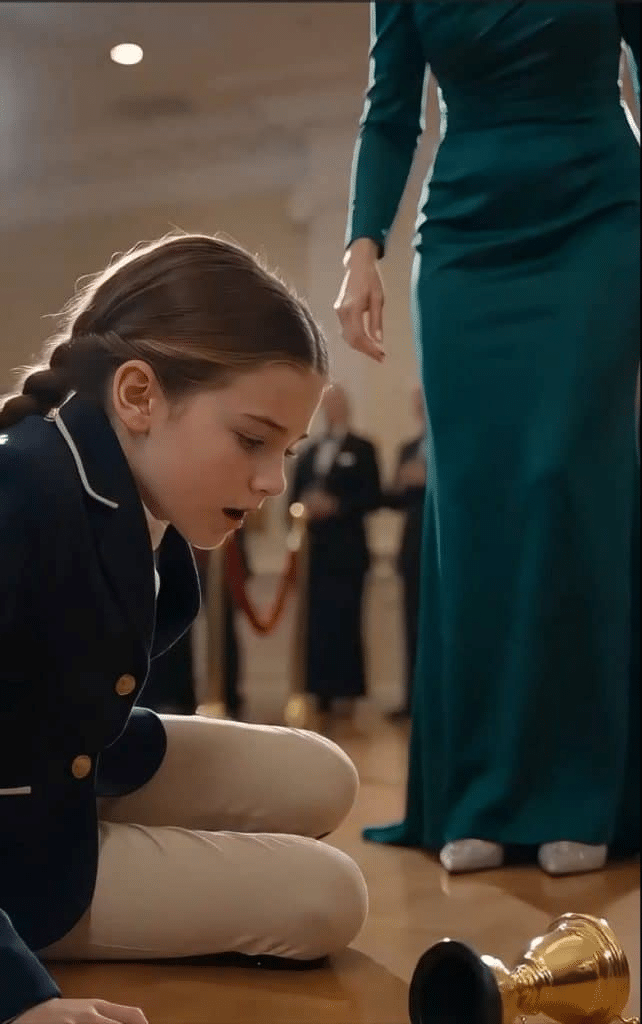
The slap cracked across the equestrian gala hall, and the small gold trophy rolled across the carpet.
For one frozen second, the screen behind the stage kept glowing.
Ashford Stables.
Miss Clara Ashford hit the floor beside the trophy stand, one hand catching herself before her shoulder struck the polished wood. Her old navy riding jacket twisted at the collar. A small mark of blood appeared near her lip, and dust from her riding boots streaked the edge of the carpet.
The trophy rolled until it tapped the velvet rope.
Then it stopped.
Around her, the gala went silent.
Gold trophies glittered beneath warm lights. Framed portraits of champion horses stared down from the walls. Elegant riding gear sat displayed behind glass. Wealthy guests in evening wear stood around the hall with champagne flutes, diamond pins, and the quiet arrogance of people who believed bloodlines applied to more than horses.
Standing over Clara was Beatrice Colton.
Auburn hair. Emerald evening gown. Diamond horse brooch shining against her chest. A cold smile that looked practiced in mirrors and sharpened in stables where money mattered more than mercy.
She had slapped Clara for touching the trophy.
Not stealing it.
Not damaging it.
Touching it.
Beatrice leaned down, her voice cutting through the silence.
“Bloodlines matter here,” she said. “Little barn trash like you doesn’t touch trophies.”
A few guests inhaled.
No one moved.
Clara looked at the trophy first.
Then at the screen.
Ashford Stables.
Then at Beatrice.
Her steady eyes had gone colder, but not weaker. She did not beg. She did not explain. She only pushed one knee under herself and began to rise with the strange dignity of a child who had been taught that falling in public was not the same thing as losing.
Beatrice’s smile twitched.
“What?” she snapped. “Are you going to cry to the stable hands?”
The MC stepped down from the stage.
His tuxedo was neat, but the trophy card in his hand trembled. He moved quickly through the crowd, microphone still clutched at his side. His face had changed from gala polish to shock.
Then he reached Clara.
He lowered himself beside her with sudden respect.
“Miss Ashford,” he said, voice clear enough for every stable owner, rider, donor, and guest to hear, “your family’s horse has just been named champion.”
The room gasped.
The large screen updated behind him.
Ashford Stables Champion.
Beatrice’s face emptied.
Her eyes moved from the screen to Clara’s old jacket, then to the trophy still resting by the rope.
Her lips barely opened.
“Ashford?”
Clara picked up the gold trophy slowly.
The girl Beatrice had called barn trash was the child of the stable whose horse had just beaten every bloodline in the room.
Act II
Clara Ashford had learned horses before she learned society.
Her first memory was not of a mansion, a gala, or a polished trophy room. It was the smell of hay after rain and the sound of her grandfather’s boots crossing the stable aisle before dawn.
Thomas Ashford never walked loudly around horses.
He believed noise was what people used when they did not know how to be trusted.
He built Ashford Stables from three aging mares, one stubborn gelding, and a patch of land everyone said was too muddy to produce champions. His family had money once, but not the kind that survived bad marriages, bad investments, and men who enjoyed calling themselves visionary. By the time Thomas inherited the property, the Ashford name was old enough to impress people and broke enough to amuse them.
He did not care.
He cared about horses.
He cared about hands that knew when to tighten a girth and when to wait. He cared about riders who listened with their seat before using their reins. He cared about grooms, farriers, barn managers, exercise riders, and the quiet people who made champions possible before owners arrived for photographs.
He taught Clara the same way.
“Never confuse pedigree with character,” he told her. “A horse can be bred like royalty and still refuse the jump.”
Clara loved that.
She grew up in old riding jackets patched at the elbows, boots that never stayed clean, and mornings so cold her fingers ached around the reins. She learned to muck stalls before she learned to smile for donors. She learned that expensive riders often blamed horses for human impatience. She learned that the best animals remembered kindness longer than fear.
Her favorite horse was Marigold.
The name sounded soft, but the mare was not.
Marigold was a dark bay with a white star, sharp ears, and a talent for making arrogant riders look foolish. She had been dismissed as too sensitive, too difficult, too nervous under bright lights. A rival stable had sold her quietly after two failed seasons, calling her “temperamental stock.”
Thomas bought her anyway.
Clara was nine when she first saw the mare.
“She’s angry,” Clara whispered.
Thomas nodded.
“Then someone gave her reason.”
No one expected Clara to bond with Marigold.
That was why it happened.
She sat outside the stall for weeks reading homework aloud while the mare watched from the shadows. She brought apples but did not force them. She waited. And waiting, in the world of horses, can become a language.
Eventually, Marigold came forward.
Then she lowered her head.
Then she let Clara touch the white star between her eyes.
From that day forward, the girl and the mare belonged to each other in a way adults found inconvenient.
Clara was too young to ride Marigold in major shows, but she helped train her. She knew which saddle made the mare tense. She knew which bit made her fight. She knew that loud applause frightened her less than people rushing behind her.
Thomas watched them together and began making plans.
Not for fame.
For justice.
Marigold would compete again under Ashford colors, with a patient rider and a stable that did not punish sensitivity for being inconvenient.
The gala that night was supposed to honor the regional champions.
No one told Clara that Marigold had been favored.
Thomas wanted her to hear the announcement with everyone else.
So Clara came in the old navy riding jacket he had given her, beige pants, dusty boots, and a braid tied neatly down her back.
She looked like a child from the barn.
Which, to Clara, was not an insult.
To Beatrice Colton, it was everything she needed to decide who the girl was allowed to be.
Act III
Beatrice Colton believed horses confirmed the superiority of people who already had it.
Her stable, Colton Ridge, was famous for bloodlines, auction prices, imported trainers, and riders whose uniforms looked expensive even after a fall. She spoke of breeding the way some families spoke of ancestry, as if purity and value were the same thing.
Her mare, Silver Duchess, had been expected to win that night.
The champagne had been poured around that assumption.
Her guests had gathered around that assumption.
The diamond horse brooch on her gown seemed to sparkle around that assumption.
Beatrice had already rehearsed humility in the mirror.
She planned to say she was honored, grateful, thrilled for the sport, proud of her team. She planned not to mention that the runner-up came from Ashford Stables, a name she considered too romantic, too old, too stubborn, and far too popular with people who cared about horsemanship more than money.
She disliked Thomas Ashford.
Everyone knew it.
Years earlier, he had publicly refused to sell her Marigold’s dam, saying, “I won’t let a good mare become décor for a breeding catalogue.”
Beatrice had never forgiven him.
When Ashford Stables began winning again, she called it sentimental judging. When Marigold qualified for championship review, she called it a publicity trick. When young Clara Ashford appeared at shows in an old jacket and dusty boots, Beatrice called her “that barn child” with the smile of someone who hoped everyone understood the cruelty and admired the restraint.
That night, Beatrice was already irritated before the announcement.
The MC had delayed the champion reveal twice. Judges had been whispering near the stage. A staff member had carried a new trophy card to the podium. The large screen continued looping Ashford Stables footage longer than seemed polite.
Then Beatrice saw Clara near the trophy table.
The girl was standing quietly beside the small gold trophy, one finger resting near its base, not touching the engraved plate yet. She was looking at it with an expression Beatrice did not understand.
Not greed.
Recognition.
That was what made Beatrice cross the hall.
“Step away from that.”
Clara turned.
“I wasn’t taking it.”
“You shouldn’t be near it.”
Clara’s eyes moved to the display.
“It’s open for viewing.”
“For guests.”
“I am a guest.”
Beatrice laughed.
Not loudly.
Worse.
Precisely.
“In that jacket?”
A few people nearby heard and pretended not to.
Clara did not look down at her clothes.
That irritated Beatrice more.
“My grandfather gave it to me,” Clara said.
“Then your grandfather should teach you where barn children stand at galas.”
Clara’s fingers curled slightly.
“My grandfather owns Ashford Stables.”
Beatrice’s smile sharpened.
“Ashford lets stable help borrow the name now?”
Clara’s chin lifted.
“No.”
One word.
Quiet.
Clean.
Too much like Thomas.
Beatrice’s temper snapped because a child had refused to perform embarrassment.
Her hand came fast.
The slap turned the hall silent.
The trophy rolled across the carpet.
And for the first time that night, Beatrice Colton’s breeding showed.
Act IV
The MC, Daniel Reeves, had announced champions for twenty years.
He had seen tears, tantrums, family feuds, drunk owners, jealous riders, and donors who believed naming rights were a substitute for knowledge. He knew how to smile through awkwardness. He knew how to keep a room moving.
But he had never seen a grown woman slap a child beside a trophy table.
And he had never imagined the child would be Clara Ashford.
Daniel knew the final card before most of the room did. Marigold of Ashford Stables had won. Not by politics. Not by sentiment. By score, movement, condition, recovery, and the kind of performance that made even rival judges go quiet.
The horse had earned it.
So had the team.
When Daniel saw Clara on the floor, blood near her lip, the small trophy by the rope, and Beatrice Colton standing over her in emerald silk, something in him hardened.
He walked down from the stage.
“Miss Ashford,” he said, “your family’s horse has just been named champion.”
The reveal moved through the hall like a crack through ice.
Beatrice looked at the screen.
Ashford Stables Champion.
Then at Clara.
Then at the framed champion horse portraits lining the walls, as if they had all turned against her.
“I didn’t know,” she whispered.
Clara rose.
She brushed nothing from her jacket. She made no effort to hide the dust on her boots. She picked up the trophy and held it with both hands, not as a prize to show off, but as something she had been trusted to carry.
“You knew I was twelve,” she said.
The hall went still again.
This silence belonged to Clara.
Not to shock.
Not to fear.
To truth.
Beatrice opened her mouth, but no language of etiquette could soften what she had done. She had not protected a trophy. She had not defended tradition. She had struck a child because she believed the child lacked the name to make the room care.
Daniel turned toward security.
“Mrs. Colton is to be escorted from the gala floor.”
Beatrice’s eyes flashed.
“You have no authority to remove me.”
Daniel held up the trophy card.
“Tonight, I announce the champion. And I won’t do it over a child’s blood.”
A murmur moved through the guests.
At the far end of the hall, an older man stepped from behind the velvet rope near the portrait display.
Thomas Ashford.
White hair. Weathered face. Black evening jacket that still could not hide the posture of a man who had spent his life around horses. He walked with a cane, but slowly enough to make the room feel his arrival.
Clara saw him and stood straighter.
Thomas did not go to Beatrice.
He went to Clara.
His eyes moved to her lip.
Then to the trophy.
Then to the old navy jacket.
“Are you hurt?” he asked.
“No.”
He looked at her for one long second.
Then nodded, accepting the answer without fully believing it.
Only then did he face Beatrice.
“Bloodlines matter here?” he said softly.
Beatrice’s face tightened.
“Thomas, this is—”
“No.”
The word landed with more force than shouting.
Thomas looked toward the champion portraits.
“I have spent my life watching people speak of bloodlines because it lets them avoid speaking of care. They praise breeding because grooming is quieter. They praise ancestry because training takes humility. They praise ownership because the people who muck stalls rarely stand near microphones.”
Beatrice’s diamond brooch trembled with her breathing.
Thomas stepped closer.
“You looked at my granddaughter and saw dust. That is because you have never understood where champions come from.”
The room did not applaud.
Not yet.
Some truths are too heavy for applause at first.
Daniel lifted the microphone.
“The 2026 Grand Champion,” he said, voice steady now, “Marigold of Ashford Stables.”
The screen filled with the mare’s image.
Dark bay coat.
White star.
Ears sharp.
Eyes alive.
Clara held the trophy against her chest, and the hall finally rose.
Act V
The video spread before the gala ended.
Fifteen seconds.
The slap.
The gold trophy rolling across the carpet.
Bloodlines matter here. Little barn trash like you doesn’t touch trophies.
Then Daniel Reeves stepping down from the stage.
Miss Ashford, your family’s horse has just been named champion.
Then Beatrice Colton’s broken whisper.
Ashford?
People loved the reversal.
They loved Beatrice’s panic. They loved the glowing screen. They loved discovering that the girl in the old riding jacket was not stable help, not a stray child near the display, but Miss Ashford of Ashford Stables.
Clara did not love the lesson people repeated.
Be careful who you disrespect. They might come from a champion stable.
That was not a lesson worth keeping.
It still made dignity depend on pedigree.
Her grandfather hated it even more.
“That woman was wrong before she learned your name,” Thomas told Clara later that night.
They were in the stable aisle, far from chandeliers and trophies. Marigold stood in her stall, calm now, her dark head lowered while Clara rested one hand against her neck.
The trophy sat on an overturned feed bucket.
It looked smaller there.
Better.
Clara touched her lip.
“She said bloodlines matter.”
Thomas looked at Marigold.
“They do. But not the way she meant.”
Clara waited.
“A bloodline is not a crown,” he said. “It’s a responsibility. You inherit the work people did before you. Not the right to stand above others.”
Marigold exhaled softly.
Clara leaned against her.
“Then why did everyone freeze?”
Thomas did not answer quickly.
Because he respected questions too much to cover them with comfort.
“Because wealth teaches rooms to hesitate,” he said. “And hesitation is where cruelty grows.”
That sentence stayed with Clara longer than the slap.
By morning, Beatrice Colton’s apology had arrived through a publicist.
It called the incident “an emotional misunderstanding in a high-pressure competitive environment.” It said Beatrice had always respected young riders, stable traditions, and the Ashford family. It expressed regret that “a moment of confusion was being misinterpreted.”
Thomas read the statement once.
Then handed it to Clara.
“What do you think?”
Clara looked at the words.
“She apologized to the cameras.”
Thomas smiled faintly.
“Yes.”
Ashford Stables released the gala footage without commentary.
They did not need any.
The equestrian world reacted fast.
Some defended Beatrice quietly, saying competition brought out emotions. Others claimed the video lacked context. But stable hands, grooms, junior riders, exercise riders, and barn kids knew exactly what they had seen.
They had heard versions of that insult their whole lives.
Barn trash.
Stable help.
Lesson kid.
Scholarship rider.
Not our circle.
Not our blood.
The clip became more than a scandal because it exposed a language everyone knew and too few people challenged out loud.
Within a week, Colton Ridge lost two sponsors, one trainer, and three promising junior riders whose parents decided ambition did not require cruelty. Beatrice was suspended from gala committees pending review, a phrase that sounded soft but felt sharp in circles where invitations were currency.
Ashford Stables changed too.
Thomas did not want the moment reduced to revenge.
He called a meeting in the main barn.
Not just riders.
Everyone.
Grooms, farriers, exercise riders, stall cleaners, veterinarians, barn assistants, drivers, feed suppliers, junior students, and parents who usually waited near the rail while others did the work.
Clara stood beside him in the old navy jacket.
The mark near her lip had faded, but the room remembered.
Thomas placed Marigold’s trophy on a bale of hay.
“This belongs here first,” he said.
A groom named Luis looked startled.
“Sir?”
Thomas turned toward him.
“You were the one who noticed her left hind was tight before qualifiers.”
Luis nodded slowly.
“You changed the wrap schedule.”
“Yes, sir.”
Thomas looked at the head groom.
“And you changed her feed.”
“She was dropping weight on travel days.”
He looked at Clara.
“And you sat with her through fireworks because she hated the sound.”
Clara looked down.
Thomas touched the trophy.
“The room last night saw a horse named champion. This barn knows how many hands made that possible.”
The trophy stayed in the barn for a month before going to the hall display.
That became tradition.
Every trophy Ashford Stables won after that spent its first thirty days in the working barn, not the formal room. Beside each one was a card listing every person who contributed to the horse’s care.
Not owner first.
Not rider first.
Everyone.
At first, visitors found it quaint.
Then they understood it was not decorative.
It was a correction.
Clara returned to riding within days, but something in her had changed. Not her love of horses. That remained. If anything, it deepened. But she began watching people the way her grandfather watched horses: not for polish, but for pressure points.
Who softened around power?
Who tightened around workers?
Who blamed the horse first?
Who praised the rider and ignored the groom?
Who said bloodlines when they meant belonging?
She grew quieter.
Sharper.
Not bitter.
Precise.
At thirteen, she began keeping a notebook titled Things People Say Near Barn Doors.
Some entries were funny.
Some were cruel.
Some became rules years later.
Do not let parents speak to grooms like furniture.
Do not let donors name horses they never visit.
Do not call fear “temperament” until checking who trained it into the animal.
A trophy without the barn is just metal.
Thomas found the notebook once.
He read one page, closed it, and said, “Good.”
From him, that was almost a speech.
Marigold continued winning, but her legacy became bigger than ribbons. She became the face of the Ashford Care Standard, a program Thomas and Clara built to train young riders in horsemanship before competition.
Not elite posture.
Not performative tradition.
Real care.
Cleaning tack. Reading body language. Stall safety. Feeding schedules. Injury signs. Groom respect. Trailering stress. Veterinary basics. The ethics of retiring a horse before pride turned selfish.
Parents complained.
Some said their children had joined to ride, not muck stalls.
Thomas would ask, “Then why did you bring them to horses?”
Several left.
Better students came.
Years passed, and Clara grew into the old jacket before finally outgrowing it. She refused to throw it away. The sleeves were patched twice. The collar remained slightly bent from the night of the gala. She kept it in her tack room, not framed, not hidden.
A reminder.
When Thomas died, the equestrian world spoke of legacy, champions, breeding, and tradition.
Clara spoke at the barn.
Not the cathedral.
Not the club.
The barn.
Marigold, old now and gray around the muzzle, stood in the open stall nearby.
“My grandfather believed horses reveal people,” Clara said.
The stable workers stood shoulder to shoulder.
“He said some people show their best selves to animals because animals cannot affect their social standing. Others show their worst selves to workers because workers can be punished for answering back.”
The barn was silent except for shifting hooves.
“He taught me that care is not softness. It is discipline. It is attention. It is humility repeated every day until the animal trusts you more than fear.”
She touched the old navy jacket folded over the rail.
“And he taught me that no title, trophy, bloodline, or last name is worth anything if it teaches you to look down at the hands that hold the reins when no one is watching.”
Clara became the owner of Ashford Stables at twenty-seven.
People expected grace.
They got standards.
She banned abusive owners from training contracts. She required junior riders to complete barn care hours. She created scholarships for working students. She made every buyer sign retirement protections. She stopped attending galas that honored owners without honoring staff.
Some called her difficult.
She considered that a compliment from people too comfortable with ease.
Beatrice Colton faded from the center of the sport but never fully vanished. Wealth rarely disappears. It waits for a quieter room. But her name carried the video with it, and every time she tried to speak about bloodlines, someone remembered the girl on the carpet and the trophy rolling away.
Years later, Clara hosted a gala of her own.
Not in a hotel hall.
In a converted indoor arena at Ashford Stables.
The floor was swept clean but not disguised. The wood smelled faintly of hay and polish. Champion portraits hung beside photographs of grooms, farriers, riders, and retired horses grazing in winter fields.
The large screen displayed one phrase.
Ashford Stables: Champions Are Made in the Quiet Hours.
The old gold trophy sat on a small table near the entrance.
A little girl in borrowed boots stopped beside it and looked up at Clara.
“Can I touch it?”
Clara looked at the child’s nervous hands.
Then at the trophy.
Then smiled.
“Yes,” she said. “Trophies are not sacred. The work is.”
The girl touched it with one finger.
Nothing shattered.
No bloodline collapsed.
No tradition died.
In fact, something healed.
People still told the story of Beatrice Colton slapping a girl beside the trophy table and discovering she was Miss Ashford, heir to the champion stable.
They loved the twist.
The gasp.
The screen reveal.
The rival owner’s face when the child on the floor became the one person the whole room suddenly respected.
But Clara never told it that way.
Because the truth was not that Beatrice slapped the wrong girl.
The truth was that she believed there was a right one.
She believed bloodlines mattered more than kindness.
Clara knew better.
Stables belonged to early mornings.
To horses breathing steam in cold air.
To hands brushing mud from legs.
To riders falling and getting up quieter.
To grooms who notice pain before owners notice ribbons.
To old jackets that remember work.
To dusty boots on polished floors.
To children learning that confidence is not looking down on others, but standing steady when they try to push you there.
When the gold trophy rolled across the carpet, the gala did not discover that Clara Ashford belonged because her family’s horse had won.
It discovered how ugly tradition becomes when it forgets the barn.
And from that night forward, Ashford Stables taught every rider the rule Thomas had lived by and Clara carried forward.
A champion is not proven by bloodline.
A champion is proven by who they refuse to trample on the way to the trophy.
