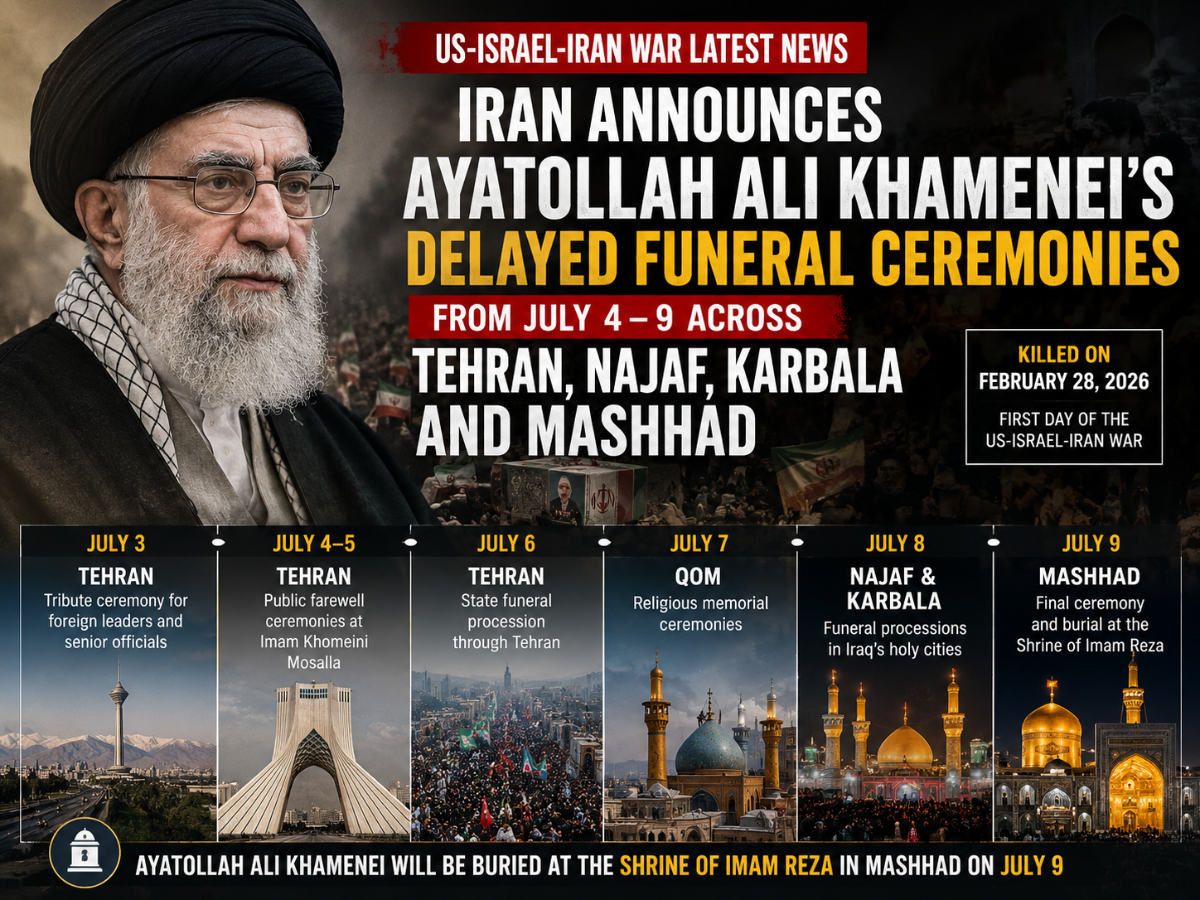
Iran has announced a delayed six-day state funeral for Supreme Leader Ayatollah Ali Khamenei, scheduled from July 4 to July 9, 2026, across Tehran, Qom, Mashhad, Najaf and Karbala.
Iran Confirms WeekLong Funeral Ceremonies for Ayatollah Ali Khamenei Across Iran and Iraq
US-Israel-Iran War Latest News: Iran has officially announced a six-day funeral programme for Supreme Leader Ayatollah Ali Khamenei, with ceremonies set to take place across Tehran, Qom, and Mashhad in Iran and Najaf and Karbala in Iraq between July 4 and July 9. The funeral comes more than four months after Khamenei was killed during the opening phase of the US-Israel-Iran war on February 28, making it one of the most delayed state funerals in Iran’s modern history.
The announcement has generated global attention, with observers questioning the reasons behind the delay and its implications for Iran’s leadership transition following Khamenei’s death.
Why is Iran holding Ayatollah Ali Khamenei’s funeral months after his death?
According to Iranian authorities, Ayatollah Ali Khamenei, who was killed on February 28, the first day of the US-Israel-Iran conflict, will receive a series of official state ceremonies before his final burial.
The months-long delay has fueled speculation about Iran’s political transition, including questions surrounding Mojtaba Khamenei, the Supreme Leader’s son and widely discussed successor. Critics of the Iranian government also claim the extended timeline is intended to increase public participation and showcase support for the Islamic Republic.
Ayatollah Ali Khamenei’s funeral schedule: Tehran, Qom, Najaf, Karbala, and Mashhad dates
According to Iran’s semi-official Fars News Agency, the funeral programme will unfold as follows:
- July 3: Tribute ceremony for foreign dignitaries, heads of state, and senior officials in Tehran.
- July 4–5: Public farewell ceremonies at Imam Khomeini Mosalla, Tehran.
- July 6: State funeral procession through Tehran.
- July 7: Religious memorial ceremonies in Qom, one of Iran’s leading Shiite seminaries.
- July 8: Funeral processions in Najaf and Karbala, Iraq’s two holiest Shiite cities.
- July 9: Final funeral ceremony and burial in Mashhad.
Which world leaders and foreign dignitaries are expected to attend Ayatollah Ali Khamenei’s funeral?
Iran has scheduled a special tribute ceremony on July 3 in Tehran for foreign leaders, senior government officials, diplomats, and religious figures.
While Tehran has not yet released an official guest list, the event is expected to attract representatives from countries and groups that maintain close ties with Iran. Officials from Iraq, Lebanon, and other regional allies, along with senior Shiite clerics and political leaders, are widely expected to participate. International media have also been invited to cover parts of the ceremonies.
Iraq confirms Ayatollah Ali Khamenei’s funeral ceremonies in Najaf and Karbala.
Iraqi authorities have confirmed that funeral processions for Ayatollah Ali Khamenei will be held in Najaf and Karbala, reinforcing the regional importance of the late Iranian leader among Shiite communities.
Iraq’s Popular Mobilization Units (PMU) have invited both local and international media organizations to register for accreditation to cover the ceremonies, which are expected to attract religious leaders, political figures, and thousands of mourners.
Where will Supreme Leader Ayatollah Ali Khamenei be buried?
The final burial ceremony for Ayatollah Ali Khamenei is scheduled for July 9 in Mashhad, his hometown in northeastern Iran.
He will be laid to rest at the Shrine of Imam Reza, one of the holiest sites in Shiite Islam and among the most significant pilgrimage destinations for Shia Muslims worldwide.
Who is Mojtaba Khamenei and why is he being discussed after Ayatollah Ali Khamenei’s death?
Following the death of Ayatollah Ali Khamenei, attention has turned to Mojtaba Khamenei, the late Supreme Leader’s son, who has long been viewed by analysts as a potential successor.
Although Iranian authorities have not officially confirmed any succession plans, the delayed funeral has intensified speculation over the country’s future leadership and the timeline for a political transition.
US-Israel-Iran War Latest News: Why are the funeral ceremonies being held in both Iran and Iraq?
The inclusion of Najaf and Karbala in the funeral programme reflects the religious significance of both cities to Shiite Islam and underscores the close religious and political ties between Iran and Iraq.
By holding ceremonies in both countries, Iranian authorities aim to allow Shiite followers across the region to pay their respects while emphasizing Khamenei’s influence beyond Iran’s borders.
What does the delayed Ayatollah Ali Khamenei’s funeral mean for Iran after the US-Israel-Iran war?
The unusually delayed funeral has intensified debate over Iran’s post-war political landscape. Analysts believe the extended ceremonies are intended to reinforce national unity and demonstrate the Islamic Republic’s stability following the US-Israel-Iran conflict.
Meanwhile, international observers continue to monitor developments surrounding Iran’s future leadership, particularly speculation over Mojtaba Khamenei, while critics argue the government is using the prolonged funeral schedule to maximize attendance and project political legitimacy.
Why is Ayatollah Ali Khamenei’s funeral attracting global attention?
The funeral is expected to become one of the biggest geopolitical events in the Middle East this year. It comes at a time when tensions remain high following the US-Israel-Iran war, with governments, security analysts and regional observers closely watching Iran’s political transition, foreign relations and succession process.
The funeral of Supreme Leader Ayatollah Ali Khamenei will span July 4 to July 9 across Tehran, Qom, Mashhad, Najaf, and Karbala, making it one of the largest cross-border state mourning events in recent Middle Eastern history. The ceremonies are expected to draw senior Iranian officials, foreign delegations, religious leaders, and thousands of mourners as Iran marks the end of an era following the US-Israel-Iran war.