
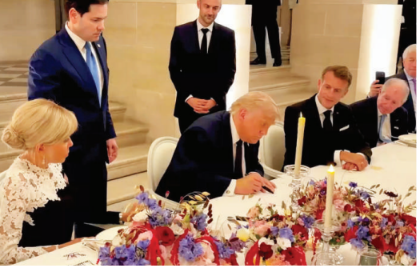
Donald Trump signed the Iran MoU at the Palace of Versailles.
The real test of the Islamabad Memorandum will not be the photographs, signatures, or press conferences. It will be what happens in the months that follow.
History has a peculiar habit of repeating itself, not as tragedy or farce, but as carefully choreographed diplomacy wrapped in grand declarations. The recently announced “Islamabad Memorandum” between the United States and Iran, brokered by Pakistan, is being hailed by some as a breakthrough in one of the most volatile geopolitical confrontations of the 21st century.
Yet beneath the celebratory headlines is a more fundamental question: can any agreement between Washington and Tehran survive if Israel believes it threatens its national security?
The answer, in all probability, is no.
The memorandum , signed by U.S. President Donald Trump and Iranian President Masoud Pezeshkian, with Pakistan acting as mediator and witness, commits both nations to a temporary cessation of hostilities and a framework for future negotiations. It is being presented as a diplomatic triumph for all involved. Trump claims credit for avoiding war. Iran portrays it as proof that American pressure failed to break its resolve. Pakistan celebrates its emergence as a major diplomatic player capable of bringing adversaries to the same table.
When every participant declares victory simultaneously, it is often a sign that the real battle has merely shifted from the battlefield to the negotiating table.
What makes the Islamabad Memorandum particularly intriguing is not the agreement itself, but the decision to place Pakistan at the centre of a diplomatic process involving some of the world’s most consequential security concerns.
For decades, Middle Eastern diplomacy has largely been shaped by regional powers such as Saudi Arabia, Egypt, Qatar, Turkey and, increasingly, the United Arab Emirates—nations that possess both economic weight and strategic influence across the region.
Pakistan’s emergence as mediator raises more questions than it answers.
A country grappling with economic instability, political uncertainty, internal security challenges and a limited ability to shape outcomes beyond its immediate neighbourhood is an unlikely guarantor of a lasting agreement between the United States and Iran.
Mediation is not merely about bringing parties to a table; it is about possessing the credibility, leverage and strategic influence necessary to ensure commitments are honoured long after the cameras have departed.
While Islamabad maintains relations with Washington, Tehran and Beijing, relationships alone do not translate into influence.
The real question is whether Pakistan possesses the diplomatic capital to manage the inevitable crises that will emerge once disagreements resurface.
There is little evidence that it does.
This is why the Islamabad Memorandum appears jinxed from the very beginning. A deal is only as strong as the confidence its guarantor inspires. Pakistan may have facilitated a conversation, but facilitating a conversation and securing a durable peace are two entirely different achievements. If the agreement encounters turbulence—as most agreements involving Iran eventually do—Islamabad is unlikely to possess either the influence or authority required to keep the parties aligned.
In that sense, the choice of mediator may ultimately become one of the agreement’s greatest weaknesses. The memorandum was presented as a diplomatic breakthrough, but from its very inception it carried the burden of being anchored to a mediator whose capacity to sustain such a complex geopolitical arrangement remains deeply questionable.
In this crisis, Pakistan assumes that it successfully transformed those relationships into diplomatic leverage. But diplomacy and durability are two very different things.
The biggest weakness of the Islamabad Memorandum is that it postpones rather than resolves the issues that have driven tensions for decades. Iran’s nuclear programme remains a source of deep concern. Tehran’s ballistic missile capabilities remain intact. Its relationships with regional proxies continue to influence conflicts across the Middle East. Sanctions relief remains conditional. Regional security arrangements remain uncertain. In essence, the agreement addresses symptoms while leaving the underlying disease untouched.
And that disease has a name: trust. Or more accurately, the complete absence of it.
But there is an even larger obstacle standing between the memorandum and long-term success.
Israel.
Many analysts discuss US-Iran relations as though they exist in a vacuum. They do not. Any serious assessment of the Middle East must acknowledge a reality that has shaped regional politics for decades: no American administration can sustain a strategic arrangement with Iran if Israel believes that arrangement undermines its security.
For Israel, Iran is not simply another geopolitical rival. It is viewed as an existential threat. Israeli security doctrine has consistently regarded Iran’s nuclear ambitions, missile programme, and regional influence as direct dangers to the survival of the Jewish state.
That perception is not going to change because diplomats gathered in Islamabad and signed a memorandum.
The fundamental flaw in the Islamabad Memorandum is the assumption that a US-Iran understanding can survive without Israel’s confidence. It cannot.
The relationship between the United States and Israel extends far beyond traditional diplomacy. It is built upon intelligence sharing, military cooperation, technological partnerships, and deep political support within the American establishment. Regardless of who occupies the White House, Israeli security concerns remain a critical factor in American strategic decision-making.
Pakistan may have successfully brought Washington and Tehran to the same table, but it cannot bring Jerusalem to the same level of comfort.
Unless Israel is convinced that Iran’s capabilities and intentions no longer pose a threat, resistance to the agreement will persist. That resistance will influence policymakers in Washington, shape congressional debates, impact defence planning, and ultimately affect the future of the deal itself.
This is why many observers are celebrating a diplomatic achievement while ignoring its most significant vulnerability.
A peace agreement that lacks Israeli confidence is not a peace agreement. It is a temporary arrangement awaiting its next test.
Donald Trump, of course, sees the matter differently.
Trump has always approached foreign policy as a negotiator rather than a traditional strategist. His instinct is transactional. He seeks leverage, pressure, concession, and ultimately a deal that can be presented as a victory.
The Islamabad Memorandum bears all the hallmarks of that approach.
After months of escalating tensions, military posturing, economic disruption, and fears of wider conflict, all parties found themselves facing increasing costs. Energy markets were nervous. Shipping routes faced uncertainty. Regional allies worried about escalation. Under such circumstances, diplomacy became the least costly option available.
But agreements born out of necessity are not necessarily agreements built to endure.
The real test of the Islamabad Memorandum will not be the photographs, signatures, or press conferences. It will be what happens in the months that follow.
Can negotiators reach agreement on nuclear verification?
Can Washington and Tehran find common ground on sanctions?
Can Iran’s regional activities be addressed?
Can Israel be persuaded that its security concerns have been adequately met?
Those questions remain unanswered.
And unless they are answered convincingly, the memorandum risks becoming another entry in the long history of diplomatic initiatives that generated optimism but failed to transform reality.
There is also a broader lesson for the international community.
Some in Pakistan may view the Islamabad Memorandum as a diplomatic triumph over India, proof that Islamabad succeeded in placing itself at the centre of a major international negotiation while New Delhi remained on the sidelines. Such celebrations, however, may be premature.
In geopolitics, being first to the table does not necessarily mean being the ultimate beneficiary of the outcome. As the old saying goes, the early bird catches the worm, but the second rat gets the cheese.
Pakistan may have secured the headlines, the photo opportunities and the temporary recognition that comes with mediating a high-profile agreement. Yet if the memorandum ultimately collapses—as many such agreements in the Middle East have before—it is Pakistan’s credibility that will suffer first.
The mediator receives applause when a deal is signed, but also bears scrutiny when the deal unravels.
India, on the other hand, has traditionally preferred strategic patience over diplomatic theatrics. New Delhi understands that influence is measured not by who hosts a signing ceremony, but by who remains relevant when the real negotiations begin.
While Pakistan celebrates the symbolism of mediation, India continues to strengthen relationships across Washington, Moscow, Tel Aviv, Tehran and the Gulf capitals—relationships built not on a single moment of diplomacy but on long-term strategic interests.
If the Islamabad Memorandum succeeds, Pakistan will claim credit. If it fails, Pakistan will struggle to escape responsibility.
India, meanwhile, retains the advantage of distance, watching developments unfold without carrying the burden of guaranteeing an agreement whose chances of survival remain uncertain.
In international affairs, the spotlight often shines brightest at the beginning of a story. Power, however, belongs to those who shape the ending.
As for Donald Trump, he has once again demonstrated his ability to dominate global headlines and reshape diplomatic conversations.
Whether he has delivered lasting peace is another matter entirely.
The harsh reality is that peace in the Middle East cannot be built while ignoring the security concerns of the region’s most militarily capable state.
History repeatedly shows that agreements involving Iran but lacking Israeli confidence rarely endure.
That is why the Islamabad Memorandum may eventually be remembered not as the agreement that transformed the Middle East, but as a tactical pause in a conflict whose underlying causes remain unresolved.
The world may celebrate peace today.
Israel will evaluate security.
And in the Middle East, security always has the final word.
*Savio Rodrigues is the Founder and Editor-in-Chief of Goa Chronicle.

Leave a Reply