Act I
The slap landed on the private island dock, and the canvas travel bag slid hard against the rail.
For one stunned second, the turquoise water kept glittering as if nothing had happened.
Then the welcome dock went silent.
Madam Eleanor Blake fell onto the polished wooden planks, one elbow scraping lightly as her white linen sleeve twisted beneath her. A small mark of blood appeared near her lip. Her plain canvas travel bag skidded away from her hand and stopped beside the dock rail, its simple brass zipper catching the tropical sun.
Around her, paradise froze.
White-uniformed resort staff stood near the welcome gate. A small arrival boat rocked against the dock. A helicopter waited on the beach beyond the palms. Luxury guests in sunglasses stared from beneath wide-brimmed hats, frozen between curiosity and judgment.
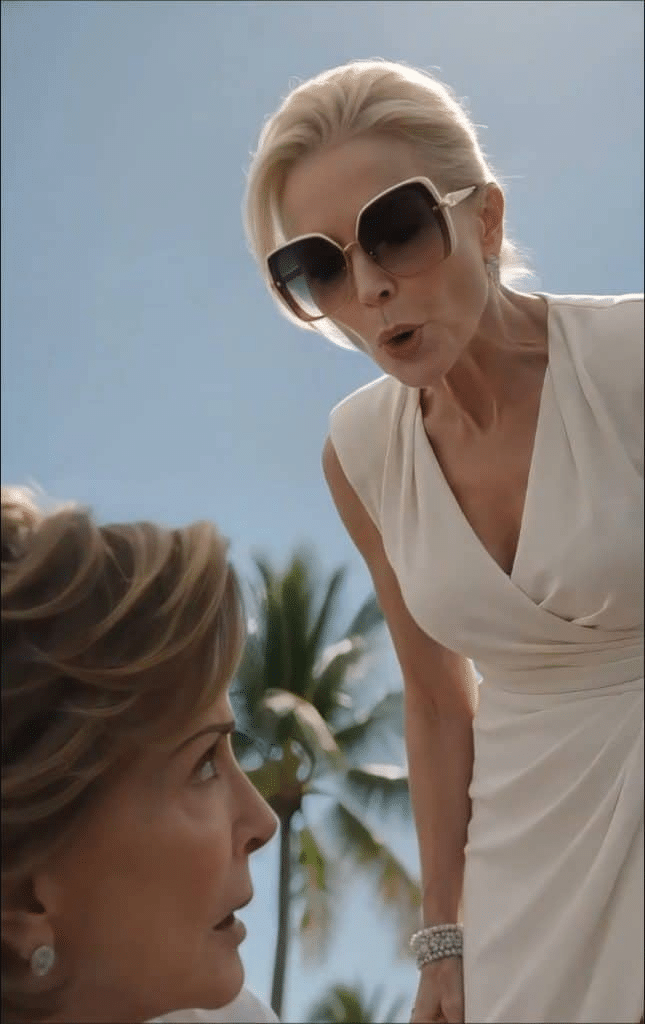
Standing over Eleanor was Vivian Crest.
Platinum hair. Oversized sunglasses. White resort dress. Diamond bracelet flashing like a warning. Her smile was bright, cruel, and perfectly practiced, the kind of smile women like her used when humiliating someone without smudging lipstick.
She had seen Eleanor step off the small boat with a canvas bag instead of designer luggage.
That was all it took.
Vivian leaned down, her voice sharp enough to cut through the sea breeze.
“This island is for people born above you,” she said, “not dockside trash arriving like staff.”
The insult seemed to bleach the sunlight.
Eleanor did not answer.
She looked first at the bag.
Then at the welcome gate.
Then at the carved wooden sign beyond it, half-hidden by palm shadows.
Blake Private Island.
Vivian did not notice.
She was too busy enjoying the silence she had created.
A beach attendant shifted forward.
Then stopped.
That pause was what Eleanor noticed.
Not the sting on her cheek.
Not the scrape on her elbow.
The pause.
An entire dock full of staff and guests had watched a woman be forced down in public, and everyone waited to see whether she had enough visible status to be defended.
Then footsteps thundered down the dock.
The resort manager ran from the welcome gate with several staff members behind him, white blazer flaring in the wind, gold name badge flashing against his chest. His face changed the moment he saw Eleanor on the planks.
Alarm.
Recognition.
Then fear sharpened into respect.
He reached her side and lowered himself with visible formality.
“Madam Blake,” he said, loud enough for the guests and staff to hear, “your island staff is assembled for inspection.”
The dock gasped.
Vivian’s sunglasses slipped lower on her nose.
The manager turned slightly, and the camera of every phone followed his gaze to the carved wooden sign.
Blake Private Island.
Vivian’s lips parted.
“Blake?”
Eleanor slowly rose, one hand closing around the handle of her canvas bag.
The woman Vivian had called dockside trash was the owner of every grain of white sand beneath their feet.
Act II
Eleanor Blake had inherited the island from a father who never trusted luxury.
Arthur Blake had bought the island in the 1980s, long before private retreats became trophies for men who measured silence by the acre. Back then, it was not a resort. It was scrub palms, hurricane damage, abandoned fishing shacks, and a dock so weak that Arthur claimed even ghosts refused to stand on it.
He was a hotel man by accident.
A builder by necessity.
A widower by tragedy.
Eleanor was twelve when her mother died, and Arthur brought her to the island because grief had made the city unbearable. They slept in a cottage with a roof that leaked during storms and ate canned soup while workers rebuilt the dock plank by plank.
Arthur made her help.
Not because he needed a child’s labor.
Because he wanted her to understand that ownership without work made people stupid.
“Never trust a person who loves a place only after it becomes comfortable,” he told her.
Eleanor remembered that.
She remembered the first staff quarters before the first villa. The first clean water system before the first infinity pool. The first hurricane shelter before the first spa pavilion. Arthur built slowly and argued with every investor who wanted luxury before infrastructure.
The island became famous anyway.
Celebrities came first. Then financiers. Then politicians who wanted photographs without questions. Then families who arrived by helicopter and complained if the coconuts were not chilled.
Arthur hated the worst of them and served them flawlessly anyway.
“Hospitality is not worship,” he told Eleanor. “We welcome guests. We do not kneel to them.”
When he died, Eleanor took over the Blake resort group and shocked everyone by refusing to expand the island beyond its ecological limits. No second marina. No casino partnership. No private owner villas. No clearing of the south mangroves. No staff housing hidden behind ugly fences while guests slept under woven ceilings and designer fans.
Her board called her sentimental.
She called them replaceable.
Then, after years of managing the island from distant offices, Eleanor heard enough whispers to make her return quietly.
Guests had grown worse.
Not all of them.
But enough.
They snapped fingers at staff. Treated local boat crews like scenery. Complained about “authenticity” while refusing to learn anyone’s name. Some staff had begun calling the welcome dock “the judgment plank,” because guests decided in the first thirty seconds who deserved courtesy and who deserved orders.
Eleanor wanted to see it herself.
So she came without announcement.
No helicopter.
No entourage.
No matched luggage.
A small arrival boat.
A white linen shirt.
Beige pants.
Flat sandals.
A plain canvas travel bag that had belonged to her father.
Inside it were inspection notes, old island maps, staff letters, and Arthur Blake’s first brass room key wrapped in a faded cloth.
She stepped onto the dock looking like someone who could be ignored.
That was the test.
Vivian Crest failed it before Eleanor reached the welcome gate.
Act III
Vivian Crest had spent her life confusing exclusivity with morality.
She had married money first, inherited more later, and sharpened both into a personality. She collected private spaces the way other people collected postcards: villas, members-only clubs, remote resorts, silent restaurants, medical spas, retreats where phones were discouraged except for photographs proving one had been invited.
To Vivian, luxury existed to confirm that some people had been selected away from others.
Blake Private Island was her newest obsession.
She had been trying to secure a founding patron package for months, even though the island had no such category. Her assistant called it “relationship building.” Vivian called it “establishing priority.”
The resort called it unnecessary.
That irritated her.
She arrived early for a wellness week with three suitcases, a personal nutritionist, a facialist, and a fury disguised as brightness. Her room had not been upgraded because no upgrade was available. The villa she wanted was reserved for a marine research delegation. The spa schedule was full. The staff greeted her with calm that felt, to Vivian, dangerously close to equality.
Then she saw Eleanor stepping off the boat.
No jewels.
No sunglasses worth naming.
No resort dress.
No driver waiting.
No luggage cart.
Just a woman with sun-worn elegance and a canvas bag moving quietly toward the welcome gate.
Vivian’s eyes narrowed.
“Excuse me,” she called.
Eleanor turned.
“Yes?”
Vivian looked her up and down.
“Staff entrance is not here.”
A few guests glanced over.
Eleanor’s face remained calm.
“I’m aware.”
“Then why are you standing on the arrivals dock?”
“I arrived.”
Vivian smiled.
Not warmly.
“With that?”
Her gaze dropped to the bag.
Eleanor held the canvas strap lightly.
“Yes.”
Vivian laughed once, sharp and bright.
“This is a private island.”
“I know.”
“Guests here pay for discretion.”
“So they do.”
“You don’t look like a guest.”
Eleanor studied her for one quiet second.
“No,” she said. “I imagine I don’t.”
That answer angered Vivian because it did not bend.
She stepped closer, lowering her sunglasses.
“People like you make places like this feel unsafe.”
The words were absurd.
But entitlement often dresses fear in expensive language.
“Unsafe?” Eleanor asked.
Vivian pointed toward the welcome gate.
“My daughter is arriving by helicopter. I’m not having random dock staff wandering into guest areas because management wants the island to look earthy.”
A staff member opened his mouth.
Eleanor looked at him once.
He stopped, unsure whether she wanted the moment to continue.
Vivian mistook that stillness for weakness.
“You should apologize,” she said.
“For arriving?”
“For forgetting your place.”
The slap came fast.
Then Vivian grabbed Eleanor’s shoulder and forced her down onto the dock.
The canvas bag slid beside the rail.
And Blake Private Island revealed, in front of everyone, how quickly paradise could become ugly when wealth thought no one important was watching.
Act IV
Resort Manager Daniel Pierce had worked for the Blake family for seventeen years.
He knew the island’s moods better than some weather apps. He knew which villas heard the surf loudest at night. He knew which guests wanted attention and which wanted invisibility. He knew which staff member had a sick parent, which boat captain sang during storms, which housekeeper could identify a returning guest by the way they folded a towel.
He also knew Madam Blake’s face.
Not from brochures.
She hated brochures.
From inspections, handwritten notes, staff briefings, and the one hurricane season when she stayed on the island for nine straight days and helped serve soup in the staff shelter after the south dock flooded.
So when Daniel saw her on the planks, blood near her lip and the old canvas bag beside the rail, his stomach dropped.
Not because she owned the island.
Because the island had failed her test.
He reached her and spoke the truth into the silence.
“Madam Blake, your island staff is assembled for inspection.”
The dock shifted.
Staff members straightened as if the sentence had pulled wire through them. Guests looked from Eleanor to the sign. The carved letters seemed suddenly enormous.
Blake Private Island.
Vivian stared at Daniel.
“No,” she said softly.
Daniel ignored her.
“Madam, are you injured?”
Eleanor rose slowly.
Her elbow stung. Her cheek burned. Her linen shirt was creased. But her face had settled into a calm so cool that even the breeze seemed to move around it.
“Not seriously.”
Daniel’s jaw tightened.
Vivian tried to recover.
“I had no idea who she was.”
Eleanor turned to her.
“You knew I was a woman alone on a dock.”
That sentence stripped the island bare.
No one could hide inside confusion. No one could call it a misunderstanding. No one could pretend Vivian had protected the resort from danger when the only threat she identified was a woman without expensive luggage.
Vivian lifted her chin.
“This has been blown out of proportion. I thought she was trespassing.”
Eleanor looked toward the staff.
“Did I cross a restricted boundary?”
A young dock attendant answered first, voice shaking.
“No, Madam.”
“Did I threaten anyone?”
“No.”
“Did I touch anyone?”
“No.”
Eleanor’s eyes returned to Vivian.
“Then what exactly did you believe gave you permission?”
Vivian’s bright smile tried to return and failed.
Daniel signaled security.
“Mrs. Crest is to be escorted to the departure lounge.”
Vivian turned sharply.
“You cannot remove me. My family reserved the Pearl Villa.”
Eleanor picked up her canvas bag.
“My island reserved the right to refuse guests who assault people on arrival.”
“My daughter is landing in ten minutes.”
“Then her helicopter can refuel and leave in eleven.”
The staff behind Daniel went still.
Not because Eleanor had raised her voice.
She had not.
Because everyone heard a boundary being restored in real time.
Vivian’s diamond bracelet flashed as her hand clenched around her phone.
“My husband knows half your board.”
Eleanor’s expression did not change.
“I own the board’s patience too.”
That was when Vivian’s face finally cracked.
Because for the first time since stepping onto the island, she understood that her money had no room to perform in.
Act V
The video spread before Vivian reached the departure lounge.
Fifteen seconds.
The slap.
The canvas bag sliding beside the dock rail.
This island is for people born above you, not dockside trash arriving like staff.
Then Daniel Pierce running down the dock.
Madam Blake, your island staff is assembled for inspection.
Then Vivian’s broken whisper.
Blake?
People loved the reversal.
They loved Vivian’s panic. They loved the carved wooden sign. They loved discovering that the woman in the linen shirt was not staff, not a trespasser, not someone to be pushed off the welcome dock, but the owner of the island itself.
Eleanor did not love the lesson people repeated.
Be careful who you disrespect. They might own the island.
That was not wisdom.
That was cowardice with better manners.
Her father would have hated it.
Arthur Blake had not built staff quarters before villas so his daughter could become another rich woman protected by name recognition. The slap was wrong before anyone knew her name. The insult was wrong before the carved sign entered the frame. The silence was wrong because the dock had hesitated when a human being was forced to the ground.
That was what Eleanor told the staff later that afternoon.
The inspection still happened.
Not as planned.
Better.
She gathered everyone beneath the shade near the welcome gate: dock attendants, housekeepers, chefs, boat crews, gardeners, spa therapists, maintenance workers, dive instructors, reception staff, beach servers, drivers, security, and managers.
Some looked afraid.
Some ashamed.
Some angry.
Daniel stood beside her, shoulders stiff with guilt.
The canvas bag rested on the table in front of Eleanor. It was stained now with a thin streak of dock dust and seawater.
“My father carried this bag on this island before there was a spa, before there was a helipad, before any guest arrived expecting chilled towels,” she said.
The staff looked at it.
“He used to say luxury is not proven by what guests receive. It is proven by what workers are not asked to endure.”
No one spoke.
Eleanor looked toward the dock.
“Today, too many of you waited.”
The sentence landed hard.
Not cruelly.
Truthfully.
A young attendant lowered his eyes.
“I’m sorry, Madam.”
Eleanor nodded once.
“So am I. Because if you waited with me, I have to ask how often you have had to wait for yourselves.”
That broke the room open.
Stories came after that.
Slowly at first.
Then faster.
Guests snapping fingers. Guests throwing towels. Guests calling boat crews “boys.” Guests telling housekeepers they were lucky to work in paradise. Guests touching staff without permission, laughing it off, then threatening reviews if anyone objected.
Daniel looked sick.
Eleanor listened to every word.
She did not interrupt.
She did not defend the brand.
By sunset, Blake Private Island had changed more than any inspection report could have managed.
Vivian Crest’s reservation was canceled permanently. Her family’s payment was refunded in full, not as apology, but as removal of leverage. Her husband’s calls went unanswered until Eleanor’s attorney sent a single sentence.
No guest purchases jurisdiction over another person’s dignity.
The island’s policies were rewritten within a week.
Any staff member could refuse service to a guest who became abusive. Any staff member could call security without waiting for a manager. Any guest who assaulted, threatened, degraded, or harassed staff or other guests would be removed regardless of booking level, family name, media profile, or private aviation schedule.
The welcome speech changed too.
Before champagne, before flower garlands, before villa assignments, guests were told the island had one rule above all others.
Respect travels both directions here.
Some guests smiled awkwardly.
Some loved it.
Some complained privately that the island had become “political.”
Eleanor circled that word on a printed complaint and wrote beside it:
Human.
The staff began calling the new policy the Dock Rule.
Eleanor disliked the name.
Then accepted it.
Because a dock was where arrival became behavior. It was the place where fantasy first met reality. It was where people decided, consciously or not, whether the island was a place they had been invited to enjoy or a world they believed they had purchased.
The Dock Rule held.
A venture capitalist was removed for screaming at a boat captain during a weather delay.
A celebrity stylist was warned after insulting a housekeeper’s accent.
A honeymoon guest was told, firmly, that drunkenness did not turn staff into entertainment.
Several wealthy families never returned.
The staff turnover dropped.
The service improved.
The island became quieter, not because guests were more powerful, but because workers were less afraid.
Eleanor stayed on the island longer than planned.
She moved into her father’s old bungalow instead of the owner’s villa. She walked the service paths before sunrise. She ate in the staff dining room without ceremony. She inspected laundry rooms, boat sheds, kitchen storage, generator housing, and the hurricane shelter.
The guests rarely recognized her unless told.
That became useful.
She learned who said thank you when they thought no one important heard it.
She learned who did not.
One morning, she found a young housekeeper named Mara standing on the dock before her shift, staring at the water.
“Are you all right?” Eleanor asked.
Mara startled.
“Yes, Madam.”
Eleanor waited.
Mara looked embarrassed.
“My mother used to clean at resorts. She told me never to look guests in the eye too long. She said some people take it as a challenge.”
Eleanor felt the sentence settle into her bones.
“What do you think?”
Mara looked out at the turquoise water.
“I think I’m tired of pretending not to have eyes.”
Eleanor smiled faintly.
“Good.”
That afternoon, she added staff leadership training to the resort budget and doubled the legal support fund for employees facing guest misconduct. Daniel called the changes expensive.
Eleanor looked at him.
“So are cowardice and lawsuits. These at least have moral value.”
He never argued again.
Months later, the island reopened its old community partnership with neighboring coastal villages, one Arthur Blake had started and later executives had quietly reduced because it was not visible enough to guests. Eleanor expanded it. Marine restoration. Hospitality scholarships. Boat safety programs. Paid apprenticeships. Staff family medical support.
The board asked whether any of it would be highlighted in the new brand campaign.
“No,” Eleanor said. “If it becomes advertising before it becomes habit, we’ve learned nothing.”
The canvas travel bag remained in her office.
Not behind glass.
On a chair near the door.
She used it.
That mattered to her.
Objects should not become sacred just because they survived humiliation. They should continue doing what they were made to do.
Years passed, and the dock video kept resurfacing.
People still framed it as karma.
VIP guest attacks secret island owner.
Rich woman humiliates resort owner.
Luxury bully slaps the wrong traveler.
Eleanor corrected the story whenever she had the patience.
“She should not have slapped a staff member either,” she would say.
That line spread slowly.
Then widely.
Hotel workers shared it. Flight attendants. cruise staff. villa managers. restaurant servers. beach crews. People who had spent years smiling through the strange violence of being called lucky while being treated as less than human.
Vivian Crest never returned to Blake Private Island.
She tried other resorts, other islands, other clubs where her money still had weight. But the clip followed her. In certain circles, she became less dangerous because people had seen the exact shape of her cruelty. Not rumored. Recorded.
For a woman who lived on controlled appearances, the truth was a permanent stain.
Eleanor did not watch the video after the first week.
She did not need to.
She remembered the dock without replaying it.
The heat of the planks.
The bag sliding.
The staff pausing.
The sharp brightness of Vivian’s smile.
Most of all, she remembered the moment after Daniel said her name, when everyone suddenly decided she had deserved respect all along.
That was the part she could not forgive easily.
Not because they respected her.
Because they needed permission to begin.
On the tenth anniversary of Arthur Blake’s death, Eleanor held a private gathering at the dock.
No guests.
Only staff and their families.
The small boat Arthur once used had been restored and tied at the rail. The helicopter remained on the beach, silent. The welcome gate was decorated not with imported flowers, but with palm fronds woven by the island grounds crew.
Eleanor stood with the canvas bag at her feet.
“My father believed arrival was a test,” she said.
The staff listened.
“He said every person reveals who they are in the first place where they think they have power.”
She looked down the dock.
“I failed that test too, in my own way. I thought policies were enough. I thought reputation was enough. I thought a place this beautiful would remind people to behave beautifully.”
A few staff members smiled sadly.
“I was wrong.”
Daniel stood near the gate, older now, still wearing the gold name badge.
Eleanor continued.
“A place does not become kind because the water is clear. It becomes kind because people are defended when defending them costs something.”
The waves moved softly under the dock.
Then Mara, now assistant operations director, unveiled a new carved sign beside the welcome gate.
Blake Private Island
Respect Travels Both Directions
Eleanor stared at it for a long time.
Then she laughed quietly.
“My father would say it’s too polished.”
Mara smiled.
“We sanded it twice.”
“He would have complained after the first.”
The staff laughed.
And the dock, once remembered for silence, filled with sound.
People still told the story of Vivian Crest slapping a modest woman on the private island dock and discovering she was Madam Blake, owner of the resort.
They loved the twist.
The gasp.
The carved sign.
The VIP guest’s face when the woman on the planks became the person who could send her away.
But Eleanor never told it that way.
Because the truth was not that Vivian slapped the wrong woman.
The truth was that she believed there was a right one.
She believed the island was for people born above others.
Eleanor knew better.
Islands were for stewardship.
For boat crews reading weather before guests wake.
For housekeepers restoring rooms after luxury makes its mess.
For cooks sweating behind perfect breakfasts.
For gardeners keeping paths clear after storms.
For staff families whose names never appear on villa plaques.
For travelers arriving tired, grieving, hopeful, or arrogant enough to need correction.
For turquoise water that belongs to no passport.
For palm trees that do not bow to money.
When the canvas travel bag slid beside the dock rail, the island did not discover that Madam Blake belonged there because she owned it.
It discovered how quickly people forget humanity when status is not immediately visible.
And from that day forward, Blake Private Island taught every arriving guest the truth carved deeper than its welcome sign.
Paradise is not where powerful people go to be obeyed.
Paradise is where no one has to kneel to make another person feel above them.