
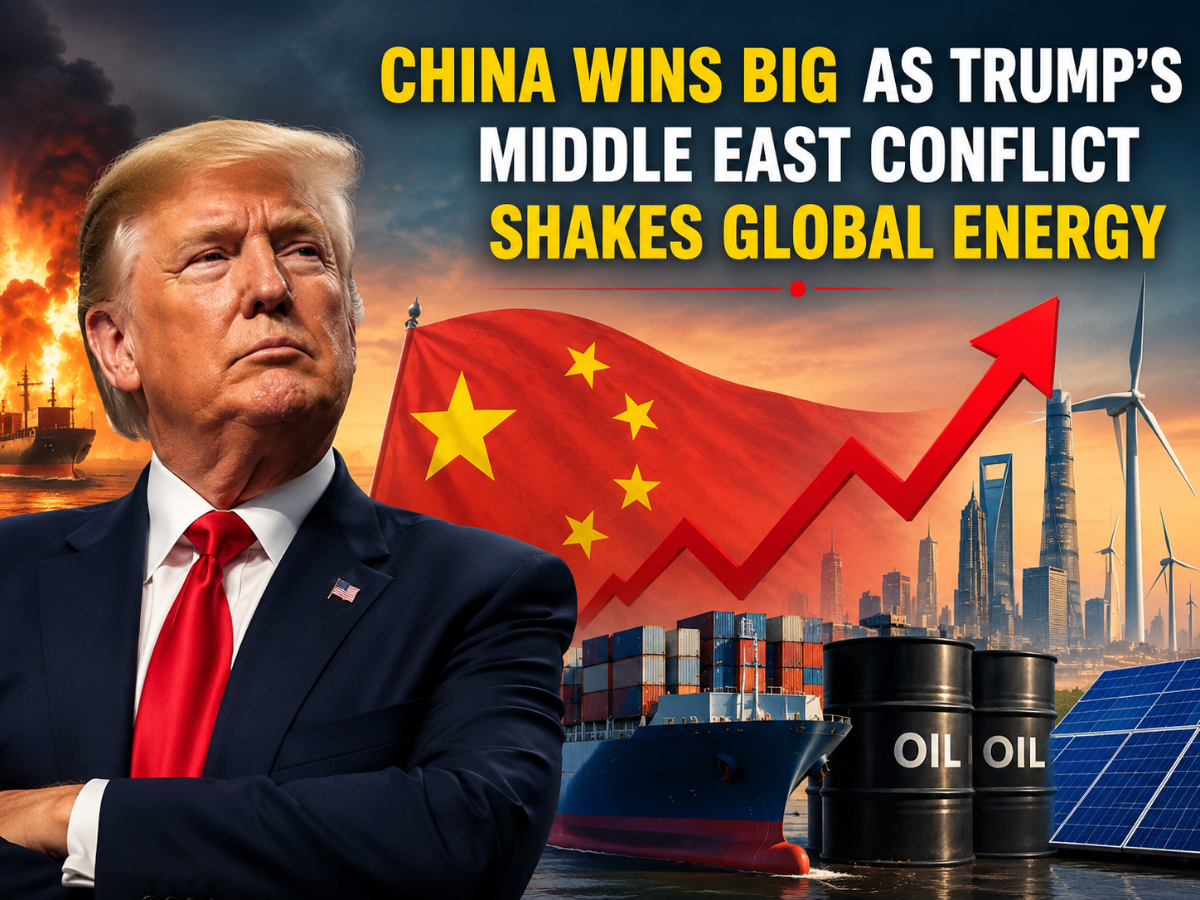
A new Asia Group report claims that Donald Trump’s military intervention in the Middle East has unintentionally strengthened China’s economic and geopolitical position.
Donald Trump News Today: A new geopolitical report has claimed that one of the biggest unintended consequences of US President Donald Trump’s military actions in the Middle East may be China’s growing economic and strategic advantage.
According to a report released by geopolitical consulting firm Asia Group, the regional conflict triggered by Trump’s decision to launch joint military strikes on Iran alongside Israel has reshaped Asia’s economic landscape. While the military campaign sought to weaken Iran, the resulting energy crisis and supply-chain disruptions have reportedly left China in a stronger position than any other major Asian economy.
The report argues that Beijing’s extensive oil reserves, rapid renewable energy expansion and dominance in electric vehicle (EV) and solar manufacturing allowed it to weather the crisis while many neighboring economies struggled with soaring energy costs.
How Did Trump’s Middle East Conflict Lead to the Energy Crisis?
The report traces the crisis back to 28 February, when the United States and Israel launched coordinated strikes targeting Iranian military and government facilities. The operation reportedly killed Iran’s Supreme Leader Ali Khamenei, sharply escalating tensions across the Middle East.
Iran responded by effectively shutting down the Strait of Hormuz, one of the world’s most strategically important shipping routes. Nearly 80% of the oil and around 90% of liquefied natural gas (LNG) transported through the waterway is destined for Asian countries, making the region particularly vulnerable.
The disruption pushed global oil and gas prices significantly higher, placing enormous pressure on energy-importing nations.
Donald Trump News Today: Why Does the Report Say China Benefited the Most?
While countries including India, Japan, South Korea and several Southeast Asian economies faced rising fuel costs and growing economic uncertainty, China entered the crisis with important strategic advantages.
According to the report, Beijing had already accumulated massive crude oil reserves after purchasing additional supplies during periods of lower global prices. Analysts estimate China had enough strategic reserves to cover roughly 100 days of oil imports, providing an effective cushion against global supply disruptions.
The Asia Group concluded that China’s preparation allowed it to absorb the energy shock better than any other major economy in Asia.
Donald Trump News Today: China’s Renewable Energy Push Reduced Its Dependence on Imported Oil
Another reason China emerged stronger was its long-term investment in renewable energy.
The report notes that China installed 315 gigawatts (GW) of new solar capacity in 2025, accounting for more than half of all global solar installations that year. It had also added 277 GW the previous year.
Beijing aims to generate nearly half of its total energy from non-fossil fuel sources by 2030, with wind and solar expected to contribute around 30% of the country’s energy mix.
Although coal remains China’s largest energy source, its rapidly expanding renewable sector reduced its dependence on imported fossil fuels during the crisis.
Trump’s Middle East Policy Also Boosted China’s Clean Energy Industry
The report says another unexpected consequence of Trump’s Middle East strategy has been stronger global demand for clean energy technologies.
As governments sought to reduce dependence on unstable oil supplies, investment in electric vehicles, solar panels, and battery technologies accelerated worldwide.
China already dominates production across these industries.
According to the report, Chinese electric vehicle exports surged by more than 110% year-on-year in May, while exports of solar equipment also recorded strong growth, allowing Chinese manufacturers to expand their global market share during the crisis.
Donald Trump News Today: How is China Turning the Crisis into a Geopolitical Advantage?
Beyond economics, the report argues that Beijing has used the conflict to strengthen its diplomatic position.
China has repeatedly called for a ceasefire while portraying itself as a supporter of regional stability. At the same time, the report says Beijing has sought to frame Trump’s military intervention as evidence that US involvement in the Middle East creates instability and imposes economic costs on countries around the world.
Analysts believe this narrative could improve China’s influence among developing nations looking for alternatives to Washington’s foreign policy.
Donald Trump News Today: Could China’s Gains Be Temporary? Experts Warn of Long-Term Risks
Despite describing China as the biggest beneficiary, the report cautions that Beijing still faces significant challenges.
China remains heavily dependent on international shipping lanes for trade, meaning prolonged instability in key maritime routes could eventually affect its own economy. Experts also note that Beijing has shown little interest in replacing the United States as the Middle East’s primary security provider, a role that would require extensive military commitments.
The report further suggests that the Strait of Hormuz crisis could influence China’s future calculations regarding Taiwan by highlighting the logistical difficulties of operating military and commercial vessels in contested waters.
Even so, the Asia Group concludes that Beijing currently views these risks as manageable and believes the economic and geopolitical opportunities created by Donald Trump’s Middle East conflict outweigh the immediate challenges.



Leave a Reply