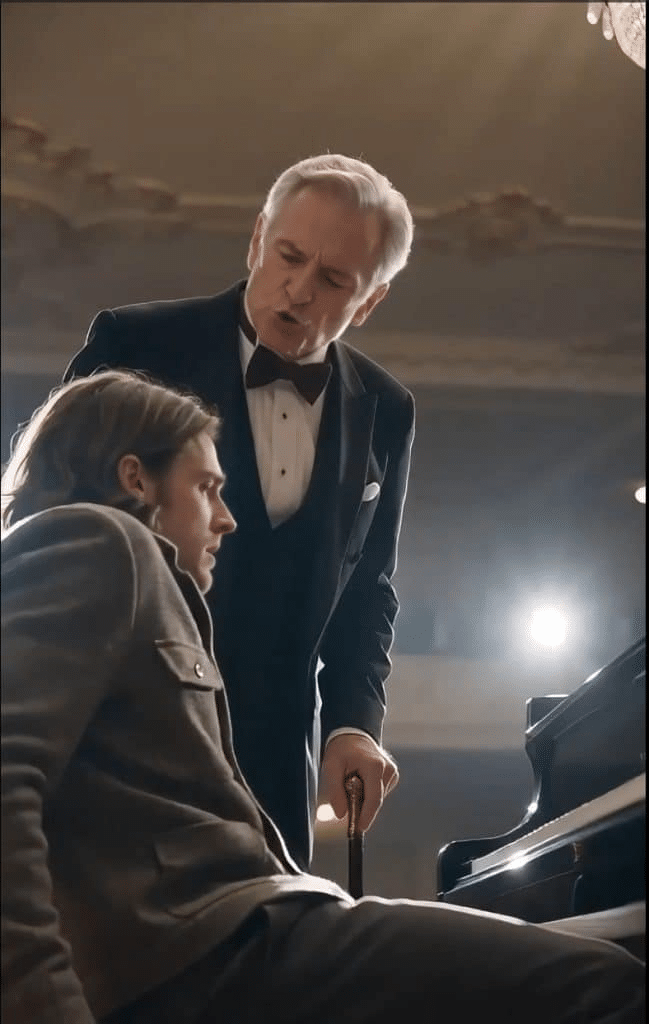
Act I
The punch landed beside the Steinway, and the piano screamed a wrong chord.
It was not music.
It was shock.
Mr. Julian Whitman fell against the piano bench, one shoulder striking the polished wood as several keys rang out beneath his long fingers. The sound cut through the grand hotel ballroom like glass breaking in church.
A small mark of blood appeared at his lip.
The bidders froze.
Velvet curtains hung motionless behind the raised stage. Gold wall panels reflected warm spotlights. Men in tuxedos held auction paddles halfway to their chests. Staff members stood silent along the aisles, their white gloves stiff around bid cards and catalogues.
At the center of it all sat the rare black Steinway.
Glossy.
Immaculate.
Old enough to carry ghosts.
Standing above Julian was Victor Langford, one of the most feared piano collectors in America. Silver hair. Black tuxedo. Burgundy bow tie. Polished cane in one hand, rage in the other. His expression was not regretful.
It was offended.
As if the piano had been insulted by Julian’s touch.
Victor stepped closer, his polished shoes stopping inches from Julian’s hand.
“Trash like you tunes instruments in back rooms,” he said, voice sharp with classist contempt. “You don’t own music, and you don’t belong near this piano.”
The ballroom went colder than the marble.
Julian stayed low.
He did not argue.
He did not plead.
He only looked at the Steinway, at the thin line of light along the open lid, where a small interior plate caught the spotlight for half a second.
Whitman Family Collection.
Victor did not see it.
He was too busy standing tall.
Too busy believing the room belonged to men who could buy sound and call it taste.
Then the auction host stepped down from the stage.
Celeste Monroe, elegant in an emerald evening gown, gripped her microphone with both hands. Her face had gone pale. She moved toward Julian with a kind of careful reverence that made the bidders lean forward.
Victor frowned.
“Celeste,” he snapped, “remove this technician.”
Celeste did not look at him.
She lowered herself beside Julian.
Her voice trembled once, then steadied.
“Mr. Whitman,” she said clearly, “your family’s Steinway collection is ready for the private sale.”
A gasp passed through the ballroom.
The camera of every phone turned toward the piano.
Inside the open body, beneath the strings and gold cast plate, the engraved words shone under the light.
Whitman Family Collection.
Victor’s hand tightened around his cane.
His mouth barely opened.
“Whitman?”
Julian slowly rose, his face reserved, cold, and unreadable.
The man Victor had called trash was the heir to the collection every billionaire in that ballroom had come to fight over.
Act II
Julian Whitman had learned music in rooms where applause was not allowed.
His grandfather, Elias Whitman, believed a piano should be heard first by the person who cared for it. Not tuned for crowds. Not polished for collectors. Heard.
Elias was not born rich.
He was born above a music repair shop in Boston, where winter air slipped through cracked windows and the floor always smelled of varnish, wool coats, and old wood. His father repaired church organs, upright pianos, school instruments, and whatever wounded machinery of sound people could afford to bring him.
As a boy, Elias slept to the uneven scales of strangers practicing in the shop below.
By seventeen, he could hear when a note was dying before anyone else noticed it was sick.
He became a piano technician first, then a restorer, then a collector almost by accident. Wealthy families sold instruments when fortunes collapsed. Old theaters discarded grand pianos when electric amplification made them seem unnecessary. Estates emptied music rooms after the last daughter married or the last son died.
Elias bought what he could.
Not as trophies.
As rescues.
He saved Steinways with cracked soundboards, Bechsteins abandoned in rehearsal halls, Bösendorfers left under sheets in mansions where no one played anymore. He kept handwritten histories for each instrument. Who owned it. Who performed on it. Who cried beside it. Which child practiced badly on it for seven years before becoming a surgeon instead of a pianist.
To Elias, music was never just performance.
It was evidence that someone had once sat alone and tried to make feeling audible.
The Steinway in the ballroom had been the heart of the family collection.
A 1904 concert grand, black as deep water, with a soundboard Elias restored by hand after finding it in a shuttered women’s conservatory. He named it Clara, after the first student whose initials were carved, nearly invisible, beneath the music desk.
Julian grew up with that piano.
His father, Nathaniel Whitman, inherited the collection but not Elias’s patience. Nathaniel loved music, but he loved prestige too. He allowed museums to borrow instruments, hosted recitals, entertained collectors, and spoke often about preserving legacy while gradually letting accountants decide which parts of legacy were too expensive to keep.
Julian was different.
He loved the silence before the first note.
He loved the physical reality of music: hammers, felt, strings, pedals, dust, wood tension, humidity. He studied piano seriously, then restoration. He could play beautifully, but he preferred listening to what an instrument needed.
That made people underestimate him.
At parties, donors mistook him for staff.
At museums, collectors mistook him for a tuner.
At auctions, men like Victor Langford mistook him for someone who had access but no claim.
Julian let them.
Not because it did not hurt.
Because his grandfather had taught him that the worst people reveal themselves fastest to those they think they outrank.
And Victor Langford had been revealing himself for years.
Act III
Victor Langford did not love pianos.
He loved possession shaped like culture.
He collected instruments the way conquerors collected flags. A piano was valuable to him when it could be described at dinner with enough detail to make others feel poorer. He knew provenance, serial numbers, famous owners, auction records, and the precise tone of voice required to make generosity sound like dominance.
He did not play.
That had never embarrassed him.
In fact, he considered it proof of refinement. Playing was labor. Owning was taste.
For fifteen years, Victor had pursued the Whitman Steinway collection.
He had offered money through brokers. Then more money through lawyers. Then private arrangements through board members who believed aging family collections should eventually enter the market, where men like Victor could “protect” them behind climate-controlled walls and invitation-only salons.
Julian’s father had been tempted.
Julian had not.
The fight nearly broke the Whitman family.
Nathaniel wanted to sell part of the collection to cover debts from bad investments and maintain the family estate. Julian wanted the instruments placed under a trust that required public access, restoration funding, and restrictions against private hoarding.
“You’re sentimental,” Nathaniel told him.
Julian replied, “You’re embarrassed that the instruments remember we came from repairmen.”
His father slapped the table that night.
Not him.
The table.
But the silence afterward felt close enough.
Elias Whitman died before the legal argument ended. His final letter to Julian was found inside the Steinway’s bench, folded between old programs from student recitals.
A piano that cannot be played is not preserved. It is buried.
Those words decided Julian’s life.
He created the Whitman Sound Trust, quietly, carefully, with the help of one attorney who still believed art was more than an asset class. The trust allowed certain instruments to be sold only to institutions, conservatories, or buyers who agreed to performance access and restoration conditions. The rarest pieces could not vanish into private vaults.
The private sale in the grand hotel ballroom was supposed to finalize that transfer.
The auction event was public theater for donors, bidders, and press, but the real collection had already been structured behind closed doors. Victor Langford came believing he could win Clara, the 1904 Steinway, if he bid high enough and humiliated enough people.
Julian came wearing a tweed coat and dark slacks.
No tuxedo.
No family ring.
No obvious marker of wealth.
He arrived early to check the piano himself.
The hotel staff thought he was a technician.
He did not correct them.
He lifted the fallboard gently and placed two fingers on the keys. The first chord was soft, almost private. The piano answered with a warmth that made his throat tighten.
For a moment, he was eight years old again, sitting beside his grandfather while snow darkened the windows.
Then Victor saw him.
“What are you doing?” Victor demanded.
Julian turned.
“Listening.”
Victor’s face hardened.
“You people always touch what you can’t afford.”
Julian closed the fallboard halfway.
“This piano can hear you.”
Victor laughed.
That laugh was the final insult before the violence.
He crossed the stage, seized Julian by the shoulder, and punched him in front of the bidders.
The wrong chord rang out.
And the ballroom heard, for one brief second, what ownership sounded like when it had no music in it.
Act IV
Celeste Monroe had hosted auctions for twenty years, and she had learned to fear collectors who spoke too tenderly about objects.
The tender ones were often the cruelest.
They could describe wood grain, ivory, lacquer, provenance, and tone with tears in their eyes, then turn cold toward the people who packed, repaired, moved, insured, and preserved the thing itself.
Victor Langford was one of those men.
Celeste had watched him reduce experts to silence, threaten junior staff, mock restorers, and refer to living musicians as “useful context.” He spent millions with elegance and wounded people with precision.
But this was different.
This was Julian Whitman on the floor beside his own family’s piano.
Celeste knew Julian, though few in the ballroom did. She had met him during the trust negotiations and found him unusually quiet for someone holding so much cultural power. He did not ask what the collection could fetch. He asked which conservatories needed playable instruments. He asked whether restoration apprentices could observe the transfers. He asked how to keep the family name from becoming a fence around the music.
Now blood marked his lip.
And Victor stood over him like a man offended by gravity.
Celeste stepped off the stage.
“Mr. Whitman,” she said, “your family’s Steinway collection is ready for the private sale.”
The line traveled through the room like a dropped match.
Victor stared at her.
Then at Julian.
Then at the piano.
A stage assistant lifted the lid farther at Celeste’s signal. The warm spotlight found the interior plate near the cast frame.
Whitman Family Collection.
Murmurs broke loose.
“Whitman?”
“The collection owner?”
“That’s Elias Whitman’s grandson?”
Victor’s face tightened.
“I had no idea who he was.”
Julian stood slowly, one hand resting on the piano bench.
His voice was quiet.
“You knew I had a hand on a piano.”
The ballroom went silent.
That was the sentence no one could escape.
Victor had not punched him because he feared damage. He had punched him because he believed beauty had a class boundary, and Julian looked like someone hired to approach it from the back.
Victor lifted his cane slightly.
“This is being exaggerated.”
Celeste turned to security.
“Mr. Langford is no longer a qualified bidder.”
His eyes flashed.
“You cannot remove me from this sale.”
“I just did.”
“I am prepared to offer eight figures for that instrument.”
Julian looked at the Steinway.
“No.”
The word was soft.
Final.
Victor stared.
Julian continued, “Clara will not be sold to you.”
The use of the piano’s name shifted the room again.
Not the model.
Not the lot number.
Clara.
A living name for an instrument Victor had treated as a prize.
Victor’s voice dropped.
“You will regret insulting me.”
Julian’s face remained cool.
“You mistook refusal for insult because no one has denied you gently in a long time.”
Several bidders looked down.
Celeste stepped closer to Julian.
“The private sale documents are ready.”
Julian nodded once.
“Then let’s finish this properly.”
And for the first time that night, the room understood that the piano was not waiting for the highest bid.
It was waiting for someone worthy of hearing it.
Act V
The video spread before the sale concluded.
Fifteen seconds.
The punch.
The wrong chord.
Trash like you tunes instruments in back rooms. You don’t own music, and you don’t belong near this piano.
Then Celeste Monroe stepping down in emerald silk.
Mr. Whitman, your family’s Steinway collection is ready for the private sale.
Then Victor Langford’s broken whisper.
Whitman?
People loved the reversal.
They loved Victor’s panic. They loved the engraved interior plate. They loved discovering that the man in the tweed coat was not a technician trespassing near wealth, but the heir to the Whitman Family Collection.
Julian did not love the lesson people repeated.
Be careful who you disrespect. They might own the piano.
That was not music.
That was merely snobbery turning around.
His grandfather would have hated it.
Elias Whitman had spent his life rescuing instruments from people who treated them as décor, inheritance, liquidation, or proof of class. He had not built the collection so Julian could become another gatekeeper standing between sound and the world.
So Julian completed the sale differently.
The Steinway named Clara did not go to a private collector.
It went to a conservatory in New York under conditions that made several lawyers visibly tired. It had to be played. It had to be maintained by trained restoration fellows. It had to be available for student recitals, public recordings, and an annual free concert honoring the unknown musicians who had practiced on it long before collectors knew its value.
Three other instruments went to regional music schools.
Two went to museums with performance programs.
One went to a historically Black college with a growing music department and a cracked old concert grand Julian remembered from a site visit. The dean cried when the agreement was signed.
Victor Langford sent legal threats within the hour.
Then reputation threats.
Then private apologies through intermediaries who used phrases like “unfortunate misunderstanding” and “heightened auction tension.”
Julian ignored all of them.
Celeste preserved the ballroom footage.
The hotel banned Victor from future cultural auctions. Other houses hesitated at first, then quietly followed. Not out of moral courage alone. Auction houses are businesses, and Victor had made himself expensive in a new way.
He was no longer a difficult client.
He was a liability with a cane.
The deeper consequences came later.
Former staff began speaking. Piano movers. Junior appraisers. Restoration technicians. Musicians hired to demonstrate instruments at private events. People Victor had insulted, underpaid, dismissed, or humiliated because they touched beauty without owning it.
One tuner wrote, He loved pianos most when no one else was allowed to play them.
That sentence followed him everywhere.
Julian kept working.
Not publicly at first.
He hated interviews. He disliked being photographed. Fame made him feel like an instrument moved into the wrong room.
But the Whitman Sound Trust needed a voice, and he had inherited more than pianos. He had inherited responsibility.
A year after the ballroom incident, Clara was played in her first public concert under the trust.
The hall was not filled only with donors.
Julian made sure of that.
Students sat beside patrons. Technicians sat beside critics. Retired music teachers sat beside wealthy collectors who seemed slightly uncomfortable without assigned social altitude. In the first row, every restorer who had worked on the Steinway was given a seat.
Celeste attended too.
She wore emerald again, perhaps by accident, perhaps not.
Before the performance, Julian walked onto the stage.
He wore the same tweed coat.
The audience noticed.
So did he.
He rested one hand lightly on the Steinway.
“This piano has belonged to my family,” he said, “but it has never belonged only to us.”
The room quieted.
“It belonged to the students who played it badly before they played it well. To the women at the conservatory where it once stood. To my grandfather, who restored it when others thought it was finished. To the technicians who kept it alive. To every person who understood that an instrument is not preserved by silence.”
He looked toward the back of the hall, where several young musicians stood because the free seats had filled.
“Tonight, it belongs to whoever listens.”
Then he stepped away.
The pianist was not famous.
That was Julian’s choice.
She was a nineteen-year-old scholarship student named Amara Lewis, who had written to the trust saying she wanted to play Clara because her grandmother cleaned practice rooms at a music school and used to pause outside doors just to hear students rehearse.
Amara sat at the bench.
For a moment, her hands hovered above the keys.
Then she played.
The first chord was quiet.
Not grand.
Not theatrical.
A single opening that seemed to ask permission from the room and receive it from the wood itself.
Julian closed his eyes.
The piano sounded alive.
Not because it was old.
Because it was being trusted again.
Years passed, and the clip of Victor punching Julian never fully disappeared.
People still shared it as karma.
Collector humiliates heir.
Billionaire punches secret owner.
Snob attacks the wrong man beside rare Steinway.
Julian corrected the story whenever he had the patience.
“He should not have attacked a technician either,” he would say.
That line became more famous than he expected.
Technicians wrote to him. So did tuners, movers, stagehands, accompanists, page-turners, music teachers, and pianists who had spent years watching donors receive applause while the people keeping instruments alive disappeared through side doors.
The trust expanded.
It created apprenticeships for piano restoration. It funded instrument repairs in public schools. It built a traveling program that brought restored pianos into communities where children had only seen concert grands in movies or behind velvet ropes.
At every event, Julian insisted on one ritual.
Before anyone performed, the technician spoke.
Not long.
Just enough to explain what had been repaired, what had been saved, what the instrument had survived.
At first, audiences found it unusual.
Then they began listening differently.
They heard the piano as wood, wire, felt, labor, memory, and breath before melody. They learned that beauty did not arrive polished by magic. Someone tightened. Someone tuned. Someone lifted. Someone repaired the damage no applause would ever see.
Victor Langford eventually sold most of his collection.
Not because he became humble.
Because rooms changed around him.
People stopped admiring possession without access. Foundations asked whether his instruments were played. Journalists asked how many sat in storage. Musicians declined invitations to perform in his private salons after the footage resurfaced too many times.
The world had not become fair.
But one corner of it had become less impressed by locked doors.
Julian visited Clara often.
Never during donor events.
He liked mornings, when the conservatory smelled faintly of coffee and floor polish, and students moved through hallways half-awake with sheet music under their arms. Sometimes he heard scales. Sometimes wrong notes. Sometimes laughter after mistakes.
Those were his favorite sounds.
One morning, he found a young boy standing beside the Steinway, hands behind his back, afraid to touch the keys.
“Do you play?” Julian asked.
The boy shook his head.
“My mom cleans here. I’m waiting for her.”
Julian sat on the bench and played one simple note.
Then another.
The boy watched.
“Your turn,” Julian said.
The boy’s eyes widened.
“Am I allowed?”
Julian thought of the ballroom.
Victor’s fist.
The wrong chord.
The insult.
You don’t own music.
He moved aside.
“Yes,” he said. “That’s the point.”
The boy pressed one key.
The sound was small.
It was also enough.
People still told the story of Victor Langford punching a man beside a rare Steinway and discovering he was Mr. Whitman, heir to the family collection.
They loved the twist.
The gasp.
The engraved plate.
The collector’s face when the man on the floor became the one person who could deny him the piano.
But Julian never told it that way.
Because the truth was not that Victor punched the wrong man.
The truth was that he believed there was a right one.
He believed technicians belonged in back rooms.
He believed ownership made him closer to music than the hands that tuned it, moved it, repaired it, or played it when no one important was listening.
Julian knew better.
Music belonged to pressure.
To wood remembering weather.
To fingers practicing after midnight.
To grandfathers saving instruments no one wanted.
To students making ugly sounds until beauty arrived.
To tuners with sore backs.
To teachers counting beats.
To mothers cleaning hallways outside practice rooms.
To every person who has ever touched a key and hoped the note would understand something words could not carry.
When the wrong chord rang through the ballroom, the bidders did not discover that Julian Whitman belonged near the Steinway.
They discovered that music had never belonged to the highest bidder.
And from that night forward, every instrument in the Whitman Family Collection carried the same rule in its paperwork and its soul.
A piano is not preserved when it is owned.
It is preserved when it is heard.